EnergyBS
    Appliances

    Microwave Repair Cost 2026: What Repairs Really Cost, by Part

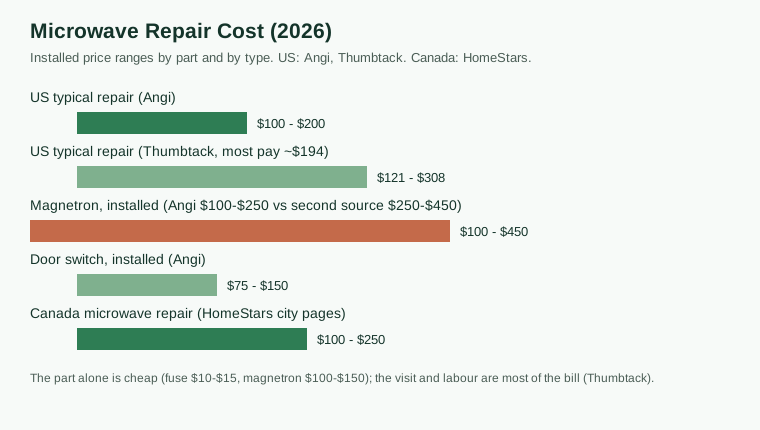
    Most microwave repairs cost $100 to $200 in the US in 2026 (Angi, updated October 23, 2026), with a national average near $194 on Thumbtack data and most repairs landing between $100 and $350 on a second published source. Angi prices the work by part: a door switch $75 to $150, a turntable motor $80 to $150, a fuse or diode $75 to $130, a control panel or keypad $100 to $200, and a magnetron $100 to $250, while a second source puts the magnetron at $250 to $450 and the control board at $200 to $400. Countertop units run $75 to $200 to fix and built-in or drawer units $150 to $500, and in Canada microwave repair runs $100 to $250 in the HomeStars city cost pages. This guide prices repairs by symptom and by part, explains why the magnetron rows disagree between sources, works the repair-or-replace decision on three labelled examples, and marks the one fault where the answer is to replace the microwave and stop using it.

    EnergyBS Editorial Team7 sources38 min read
    Microwave Repair Cost 2026: What Repairs Really Cost, by Part

    Quick Checks

    • 1Budget $100 to $200 for a typical US microwave repair in 2026 (Angi, updated October 23, 2026). Thumbtack puts the national average range at $121 to $308, with most people paying around $194, and a second source puts most repairs at $100 to $350.
    • 2Angi prices the work by part, installed: a door switch $75 to $150, a turntable motor $80 to $150, a fuse or diode $75 to $130, a control panel or keypad $100 to $200, and a magnetron $100 to $250. A second source prices the magnetron at $250 to $450 and the control board at $200 to $400, so a magnetron quote needs the parts-and-labour split stated before it can be judged.
    • 3The microwave is the one appliance in this series where the type changes the answer more than the part. A countertop unit runs $75 to $200 to fix (Angi) and a new one costs $100 to $600 (HomeGuide), so a $250 magnetron job on a $120 countertop microwave fails the 50 percent test on its face. A built-in unit at $150 to $400 to fix is a different decision.
    • 4A microwave that runs but does not heat has four possible causes, not one: magnetron, high-voltage diode, capacitor, or door switch. The magnetron is the most expensive of the four, so a quote that names it without naming the test that cleared the other three is a guess with a $250 to $450 price tag.
    • 5Never open a microwave to reach a magnetron, capacitor, transformer or diode. The capacitor can hold a lethal charge after the unit is unplugged, and every source in this guide draws the same line: bulbs, trays and filters are owner work, high-voltage parts are not.
    • 6In Canada, microwave repair runs $100 to $250 in the HomeStars city cost pages, and the national guide prices it at about $90 per hour plus parts and labour. HomeStars publishes no Canadian by-part microwave table, so a Canadian quote should be judged against that band and itemized the same way.
    On this page(14 sections)Show
    1. Microwave Repair Cost 2026: What Repairs Really Cost, by Part
    2. The Short Answer
    3. 1. What a Repair Bill Is Made Of
    4. 2. US Prices by Part
    5. 3. Prices by Microwave Type
    6. 4. The Magnetron Rows, Explained
    7. 5. Removal and Reinstallation: The Hidden Line on Built-In Units
    8. 6. Symptom to Part: What Is Probably Wrong
    9. 7. The Capacitor: Why This Appliance Is Different
    10. 8. Repair or Replace: The 50 Percent Test, Worked
    11. 9. Canada: What a Microwave Repair Costs Here
    12. 10. The Quote Checklist
    13. Frequently Asked Questions
    14. Related Reading

    Microwave Repair Cost 2026: What Repairs Really Cost, by Part

    By EnergyBS Editorial Team | November 9, 2026

    The Short Answer

    Short Answer: Most microwave repairs cost $100 to $200 in the US in 2026 (Angi, updated October 23, 2026). Thumbtack puts the national average range at $121 to $308, with most people paying around $194, and a second published source puts most repairs at $100 to $350. HomeGuide puts microwave repair at $100 to $250 on average. Angi prices the work by part: a door switch $75 to $150, a turntable motor $80 to $150, a fuse or diode $75 to $130, a control panel or keypad $100 to $200, and a magnetron $100 to $250. In Canada, microwave repair runs $100 to $250 in the HomeStars city cost pages.

    The microwave is the cheapest appliance in the kitchen to replace and one of the most expensive to open. Both facts matter before any price makes sense, because they pull the repair-or-replace decision in opposite directions. A new countertop microwave costs $100 to $600 (HomeGuide), so a $200 repair on a $120 machine is money thrown at a box that costs less than the visit. A built-in microwave costs far more to buy and far more to remove, so the same $200 repair on that machine is a bargain. The part matters less than the box it sits in, and that is what makes this appliance different from every other one in the site's repair-cost series.

    The second thing that makes it different is the capacitor. A microwave stores a charge that can injure or kill after the unit is unplugged, and the parts that fail most often sit behind that charge. The oven, the dryer and the dishwasher all have owner-serviceable parts with clear boundaries. The microwave has a shorter list: bulbs, trays, filters and cleaning. Everything past that line belongs to a technician, and Section 7 draws the line exactly where every source in this guide draws it.

    This guide is the next piece in the site's repair-cost series, after the refrigerator, washing machine, dryer, dishwasher and oven guides. It follows the same method: published prices from Angi, HomeGuide, Thumbtack, US Appliance Repairs, CLT Appliance Repair and HomeStars, read firsthand for this article, with the disagreements printed rather than averaged away. The magnetron rows disagree by $200 between sources, and Section 4 explains why instead of hiding it. Our companion guides cover the rest of the kitchen: oven and range repair cost prices the machine the microwave usually sits above or beside, and the refrigerator repair guide covers the other appliance that runs every day.

    The repair in six steps:

    1. Name the symptom in plain words before you call: will not turn on at all, runs but will not heat, will not start when the door closes, turntable will not spin, sparks inside, loud humming, display dead or buttons dead, or trips the breaker. Each symptom maps to a short part list in Section 6, and the published prices in Section 2 cover every part on those lists.
    2. Do the free checks first: outlet live (plug in a lamp), breaker not tripped, door closing and latching with a firm click, glass tray and roller ring seated, interior clean of food splatter, and no metal or foil inside. A microwave with a tripped breaker reads exactly like a dead microwave.
    3. Stop on the safety cases in Section 7 before pricing anything: a microwave that runs with the door open, sparking that continues after cleaning, a burning smell, or repeated breaker trips. The first of those is not a repair at all. It is a replacement.
    4. Call with the brand, the model number, the type (countertop, over-the-range, built-in or drawer), the age, and the symptom ready. Ask the diagnostic fee and whether it is credited toward the repair. Angi puts minimum service fees at $60 to $100, HomeGuide puts a service call at $70 to $130, and both sources say the fee is often credited if you approve the work.
    5. Approve a diagnosis before you approve a part. On an appliance where a door switch costs $75 to $150 on Angi and a magnetron $100 to $250, the sentence you are paying for is the one that names the failed part and the test that proved it. Section 6 names the four parts behind a will-not-heat symptom so you can ask which three were cleared.
    6. Run the age and percentage tests in Section 8 before approving any job over $150. Microwave repairs are cheap enough that repair usually wins on built-in and over-the-range units, and cheap enough to lose on countertop units, and Section 8 marks the line between the two with three labelled examples.

    1. What a Repair Bill Is Made Of

    A microwave repair invoice has three layers, and the proportions are the useful part.

    The first layer is the visit. Angi puts minimum service fees at $60 to $100. HomeGuide puts an appliance service call at $70 to $130, including travel in the standard service area, diagnostics, and the first hour of labour. US Appliance Repairs puts the diagnostic fee at $60 to $100 and notes that many companies apply it toward the repair if you approve the estimate. Thumbtack's Charlotte repairer charges $70 to $75 for a service call and deducts it when the labour to make the repair costs more than that. Ask how the visit is priced before anyone is booked: flat rate, hourly, or minimum charge changes what a door-switch-sized job should cost, and whether the fee is credited if you approve the repair changes the comparison between two quotes by the full fee.

    The second layer is labour, and the microwave has the narrowest labour band in the series. Angi puts appliance repair technicians at $50 to $100 per hour, with electricians called in where the fault is in the wiring or the circuit. HomeGuide puts appliance repair labour at $50 to $125 per hour. US Appliance Repairs reports a typical repair time of 30 to 90 minutes, which is why the labour layer stays small on this appliance: most jobs are one visit, one part, and under two hours. Emergency, after-hours or weekend work carries extra charges on top of standard rates on Angi, and HomeGuide puts an emergency call-out at $140 to $400. A microwave that still heats is rarely an emergency, and the emergency fee is the easiest charge in this guide to avoid by waiting for a standard slot.

    The third layer is the part, and the microwave is unusual in how much of the bill the part can be. Thumbtack publishes the only parts-alone figures in this guide: a magnetron $100 to $150, a transformer $100 to $150, a touchpad $20 to $50, and a fuse $10 to $15, all excluding labour. Compare those with the installed rows in Section 2 and the split becomes visible. A fuse that costs $10 to $15 as a part becomes a $75 to $130 installed job on Angi, because the visit and the diagnosis are most of the money. A magnetron that costs $100 to $150 as a part becomes a $100 to $250 installed job on Angi or a $250 to $450 job on US Appliance Repairs, and the gap between those two installed rows is the subject of Section 4. A quote should say whether it is charging for the part, the visit, or both, because a $150 magnetron line on a quote is a different claim from a $150 magnetron part, and the difference is the visit and the labour you are also paying for.

    Two more charges can appear on a microwave invoice that rarely appear on other appliances. The first is the removal and reinstallation charge on over-the-range and built-in units. Angi notes that built-in and drawer models require more labour than countertop units, and HomeGuide puts built-in microwave installation at $100 to $580. A built-in repair quote that does not mention removal is not finished, because the technician has to take the unit out of the cabinet to open it and put it back when the part is in. The second is the disposal fee. Angi lists disposal of old parts or units as an additional charge where it applies, and a dead microwave that is being replaced rather than repaired still has to leave the house. Neither charge is large, and both should be named on the quote before the work starts.

    HomeGuide adds the portfolio view, the same one it publishes across appliances: annual appliance maintenance plans run $200 to $500 depending on how many devices are covered, including cleaning, inspections and tune-ups, with repair discounts in some plans. Against a microwave whose average repair is $194 on Thumbtack data, a plan's microwave share only pencils out when the same plan covers several larger appliances. Price it as a portfolio, never for the microwave alone.


    Advertisement

    2. US Prices by Part

    Angi publishes the base table for this guide, and it is the only source that prices all six common microwave parts in one installed unit. Read the table in that unit. It answers the question "what should this job cost", and it does not answer "what does this part cost alone". The only parts-alone figures available are the four Thumbtack rows in Section 1, and this guide does not build a parts-alone table from figures no source publishes.

    Microwave part What it does Angi range, 2026
    Magnetron Makes the microwaves that heat food $100 - $250
    Door switch Safety interlock, stops the unit unless the door is shut $75 - $150
    Control panel / keypad Buttons and display, the user interface $100 - $200
    Turntable motor Spins the glass tray for even heating $80 - $150
    Fuse / diode Electrical safety and power regulation $75 - $130
    Light bulb / fan Interior light and cooling $50 - $120

    US Appliance Repairs publishes a second by-part table, and it runs higher on every row that overlaps. That is the disagreement this guide prints rather than averages away.

    Microwave part Angi, 2026 US Appliance Repairs, Jul 2026
    Magnetron $100 - $250 $250 - $450
    Door switch $75 - $150 $120 - $220
    Control board $100 - $200 (panel/keypad) $200 - $400
    Turntable motor $80 - $150 $120 - $220
    Fuse $75 - $130 (fuse/diode) $100 - $170
    Diode $75 - $130 (fuse/diode) $150 - $250
    Capacitor not published $150 - $275
    Cooling fan motor $50 - $120 (bulb/fan) $150 - $250

    Three things explain the gap, and none of them is a mistake. First, the two sources price different baskets. Angi's rows are national averages across all microwave types, including countertop units where the job is a bench repair with the unit carried in. US Appliance Repairs' rows read as full installed jobs, and its own by-type table runs higher for the same reason. Second, the magnetron row carries the widest spread because the part itself varies most: Thumbtack's parts-alone magnetron is $100 to $150, so a $100 to $250 installed row means short labour on a standard unit, while a $250 to $450 row means a premium or built-in unit, a longer job, or a magnetron replaced together with its diode. Thumbtack notes that most repair techs replace the diode at the same time as the magnetron, and that pairing is one $150 to $250 diode row folded into the magnetron job. Third, the control board row carries a brand effect. Angi's $100 to $200 covers the panel and keypad on standard units, while US Appliance Repairs' $200 to $400 covers the electronic control board, and Thumbtack puts high-end Viking and Thermador repairs at $200 to $600. A board quote without a brand and a model number cannot be judged against either row, because the board is the part where the brand sets the price.

    The practical rule follows from the table, not from either source alone. A magnetron quote under $250 sits inside Angi's row. A magnetron quote between $250 and $450 sits inside US Appliance Repairs' row and needs the diode question asked: is the diode included, and is the unit built-in. A magnetron quote above $450 sits outside both rows and needs a second quote. The same test works down the table. A door switch at $150 is the top of Angi's row and the middle of the other source's row, so it is a normal price either way. A door switch at $250 is outside both rows and needs a second quote. A fuse at $170 is the top of the second source's row and above Angi's, so it is high but not impossible where the visit fee is folded in. The rows are bands, not prices, and a quote that lands inside both bands is a quote that needs no further argument.

    Two rows deserve a note of their own. The fuse row is the cheapest part in the appliance and the most misleading price in the guide. Thumbtack prices the fuse itself at $10 to $15, and notes that it may take time for the repair tech to diagnose the problem, time that could add up to more than the cost of a new unit. A $130 fuse job is a $15 part with a $115 visit and diagnosis attached, and that is a fair price for the visit, not a fair price for the fuse. The capacitor row appears only in US Appliance Repairs at $150 to $275, and it is the row that most often travels with another row: a capacitor that failed usually took the diode with it, and a diode that failed usually stressed the capacitor. A quote that names one without mentioning the other has not finished the diagnosis.


    3. Prices by Microwave Type

    The type of microwave changes the bill more than the part does, and this is the section that decides most repair-or-replace calls before the part is even named. Angi prices the work by type, and US Appliance Repairs publishes a second by-type table that runs higher on the built-in end.

    Microwave type Angi, 2026 US Appliance Repairs, Jul 2026
    Countertop $75 - $200 $100 - $250
    Over-the-range $100 - $300 $150 - $350
    Built-in $150 - $400 $175 - $400
    Drawer $150 - $400 $250 - $500
    Commercial $200 - $500 not published

    Countertop units are the cheapest to fix because they are the easiest to reach. The technician carries the unit to a bench or works on it where it sits, and there is no cabinet to open and no vent to disconnect. Thumbtack puts countertop repair labour at about $70 to $100 excluding parts, and notes that is about half the cost of a good-quality new countertop unit. That comparison is the whole story for countertop microwaves: the labour alone is half a new machine, so only the cheapest parts clear the bar. A door switch at $75 to $150 on Angi clears it. A magnetron at $250 to $450 on the second source does not, and Section 8 works that example out in full.

    Over-the-range units sit in the middle because they are built in and vented at the same time. Angi notes that over-the-range models require more time and expertise than countertop units, and US Appliance Repairs prices them at $150 to $350. The extra money is access: the unit has to come off its mounting bracket, the vent connection has to be handled, and the unit has to go back up when the part is in. HomeGuide's built-in installation figure of $100 to $580 is the closest published number for what that removal and reinstallation costs when it is priced as its own job, and a repair quote on an over-the-range unit should say whether removal is included or charged separately.

    Built-in and drawer units are the most expensive to fix and the most worth fixing. Angi prices both at $150 to $400, and US Appliance Repairs prices built-in at $175 to $400 and drawers at $250 to $500. The drawer row is the highest in either table because the unit sits in a lower cabinet, the access is awkward, and the part is often a drawer-specific control board. The reason these units are worth repairing at those prices is the replacement cost on the other side of the decision: a built-in microwave costs far more than a countertop unit to buy, and it costs installation money on top of the purchase price. HomeGuide puts a new microwave at $100 to $600 depending on type, and the built-in end of that range is where the repair math turns in favour of fixing. A $350 board job on a built-in unit that would cost $600 to replace plus $100 to $580 to install is a repair. The same $350 board job on a $150 countertop unit is a replacement.

    Commercial units are the one type this guide prices and then sets aside. Angi puts commercial repair at $200 to $500, and no other source in this guide publishes a commercial row. A commercial microwave in a workplace or a food business is a business decision with downtime costs and warranty terms that a household guide cannot price, and the household rows in this guide should not be applied to it.

    Brand matters inside every type row. Angi names GE, Whirlpool, Panasonic, Samsung, LG and Sharp as brands with readily available parts, and notes that high-end or specialty brands may need proprietary parts and authorised technicians, which pushes costs higher. Thumbtack names Viking and Thermador as the high-end brands its repairers typically see, at $200 to $600 a repair. A quote on a premium brand should name the part source, because an OEM part at $80 to $250 on Angi against an aftermarket part at $50 to $180 is a real choice with a real price difference, and the warranty terms can depend on which one is fitted.


    4. The Magnetron Rows, Explained

    The magnetron is the part this guide spends a section on, because it is the most expensive common repair, the most misdiagnosed part, and the row where the sources disagree by the most money. Angi prices magnetron replacement at $100 to $250. US Appliance Repairs prices it at $250 to $450. CLT Appliance, a repair company publishing its own 2026 figures, prices it at $100 to $300. The three rows overlap at $250 and nowhere else, and the overlap is where a fair price sits: a magnetron job costs about $250 where the sources meet, less on a standard countertop unit, more on a built-in or premium unit.

    The part itself does not explain the spread. Thumbtack prices a magnetron alone, excluding labour, at $100 to $150. A $100 to $250 installed row is therefore a $100 to $150 part with a short visit and a short job attached. A $250 to $450 installed row is the same part with a longer job, a built-in removal, or a second part folded in. The second part is usually the diode. Thumbtack notes that most repair techs replace the diode at the same time as the magnetron, and US Appliance Repairs prices the diode alone at $150 to $250. A magnetron job that includes the diode is a $250 to $400 job before labour, which is exactly where the second source's row sits. A magnetron quote that does not say whether the diode is included cannot be compared with either row, and the question to ask is one sentence: does this price include the diode.

    The diagnosis matters more than the price, because the magnetron is not the only cause of a microwave that runs without heating. US Appliance Repairs names four: magnetron, high-voltage diode, capacitor, or door switch. Its own technician tip is blunt: a microwave that will not heat does not automatically need a new magnetron, and less expensive components such as a door switch or high-voltage diode can produce similar symptoms. A proper diagnosis can save money by avoiding unnecessary part replacements. Angi's scenario table makes the same point in dollars: a magnetron failure priced at $150 to repair against a $300 replacement is a repair, but only if the magnetron is actually the failed part. A door switch at $75 to $150 on Angi fixes the same symptom for half the money, and a diode at $75 to $130 on Angi fixes it for less than half.

    Two more magnetron facts belong in any quote conversation. The first is the sound. US Appliance Repairs lists loud humming as a magnetron symptom, and a humming microwave that still heats weakly is a magnetron on its way out rather than a magnetron that has already failed. The second is the pair. A magnetron that failed after years of heavy use has usually been working alongside a diode and a capacitor of the same age, and a quote that replaces only the magnetron on a ten-year-old unit should say why the diode and capacitor were cleared. The capacitor row is $150 to $275 on US Appliance Repairs, and a second visit to replace it costs another service fee.


    5. Removal and Reinstallation: The Hidden Line on Built-In Units

    The bill anatomy from Section 1 changes with the type, and the change is the removal. A countertop repair bill is visit plus labour plus part, and the visit is often most of it. An over-the-range repair bill is visit plus removal plus labour plus part, and the removal is the line that surprises people who priced the job from a countertop table. A built-in repair bill is the same shape with a larger removal line, and a drawer repair bill is the largest of all, because the unit has to come out of a lower cabinet and the access is the worst in the kitchen.

    The numbers for removal are not published as a separate row by any source in this guide, and this guide does not invent one. The closest published figures are HomeGuide's built-in microwave installation at $100 to $580 and Angi's by-type repair ranges, which already include the access cost in the installed price. Read the by-type table in Section 3 as the whole job, removal included, and ask the quote to confirm that reading. A quote that prices the part and the labour but not the removal is not a complete quote on a built-in unit, and the removal charge that appears after the work starts is the most common surprise in this appliance.

    The visit fee works the same way across types, with one difference. Angi puts minimum service fees at $60 to $100, and HomeGuide puts a service call at $70 to $130 including the first hour. On a countertop unit, the first hour often covers the whole job, because US Appliance Repairs puts a typical repair at 30 to 90 minutes. On a built-in unit, the first hour often covers only the removal and the diagnosis, and the repair itself is a second hour. A quote should say how many hours it allows for, because an hourly rate of $50 to $100 on Angi or $50 to $125 on HomeGuide doubles quickly when a built-in unit takes two hours instead of one.

    Warranty changes the visit fee entirely. Angi notes that most warranties cover parts and labour for one to two years, and that a manufacturer or extended warranty can dramatically reduce or even eliminate the repair cost. Its scenario table prices a door switch issue at $0 against a $250 replacement, with the note that it is a repair under warranty. Check the warranty before calling, and keep the proof of purchase ready, because a warranty claim that starts after the repair is paid for is a claim that may not be paid at all. HomeGuide adds that extended warranties cost $100 to $300 for an added three to five years of coverage, and typically cover part costs but not labour, which is a narrower promise than it sounds like on a microwave where labour is half the bill.


    6. Symptom to Part: What Is Probably Wrong

    A symptom is not a diagnosis, but it narrows the part list enough to place a quote. The table below is built from the symptom lists in Angi, US Appliance Repairs and Thumbtack, with the cheapest cause listed first in each row, because the cheapest cause is the one a good diagnosis checks first.

    Symptom Cheapest cause first Typical installed cost Safe to check yourself?
    Will not turn on at all Tripped breaker, dead outlet, blown fuse, door switch, control board $75 - $400 Outlet and breaker only
    Runs but will not heat Door switch, high-voltage diode, capacitor, magnetron $75 - $450 No, cup-of-water test only
    Will not start, door closed Door switch, latch, control board $75 - $400 Latch and door alignment only
    Turntable will not spin Roller ring out of place, drive coupler, turntable motor $0 - $220 Tray and roller ring only
    Sparks inside Food splatter, metal object, damaged waveguide cover $0 - $200 Clean and inspect only
    Loud humming Fan, transformer, magnetron $50 - $450 No
    Display dead or buttons dead Keypad membrane, control board $100 - $400 No
    Trips the breaker Capacitor, transformer, wiring $150 - $350 No
    Burning smell Food residue, fan, electrical component Varies Stop using it, then call
    Runs with the door open Door interlock switch failure Replace, do not repair No, stop using it

    Four rows carry the decisions. The will-not-heat row is the one Section 4 already covered: four parts, one symptom, and the magnetron is the most expensive of the four, so the diagnosis is the purchase. The will-not-turn-on row is the one where the free checks do the most work, because a tripped breaker and a blown fuse produce the same dead unit and only one of them costs money. The sparks row is the one where cleaning is a real fix: US Appliance Repairs notes that one of the most common causes of sparking is food residue left inside the oven, and regular cleaning can prevent unnecessary service calls. The runs-with-door-open row is the one where there is no decision to make. Thumbtack states it plainly: a unit that runs when the door is not closed could be caused by a failure of the interlock switches on the door latch, it poses a safety hazard, and most repair professionals recommend purchasing a new unit. Stop using it, unplug it, and replace it.

    The turntable row is the cheapest row in the table and the one most often fixed without a visit. US Appliance Repairs lists the glass tray and roller ring as owner checks, and Angi prices a glass turntable at $40 to $100 and plastic components at $50 to $150. A tray that is not seated, a roller ring that is cracked, or a drive coupler that has slipped produces the same uneven cooking as a failed motor, and the motor row at $80 to $150 on Angi or $120 to $220 on US Appliance Repairs should only be priced after the tray and the ring have been checked. The humming row is the opposite: a loud hum is a magnetron, a transformer or a fan, and none of the three is an owner diagnosis.


    7. The Capacitor: Why This Appliance Is Different

    Every appliance in this series has a safety section, and the microwave's is the longest for a reason. A microwave oven contains a high-voltage capacitor rated at 2,100 volts or more, and it can hold a lethal charge even after the unit is unplugged. That warning appears in substance in Angi, US Appliance Repairs, Thumbtack and CLT Appliance Repair, and it is the boundary every other section respects.

    Angi draws the line at the part level: simple fixes like replacing a light bulb or a turntable roller are safe for many homeowners, while repairs involving electrical components, the magnetron, or door switches can be hazardous due to high-voltage risks and the potential to void the warranty. US Appliance Repairs draws it the same way: never attempt to replace a magnetron, capacitor, or other high-voltage electrical component yourself, because microwaves can store dangerous electrical energy even after they have been unplugged. Thumbtack adds the parts-alone prices with the warning attached: the magnetron creates the heat, and if it fails it is wise to have a professional diagnose and repair the unit because it can be dangerous to make this repair. The capacitor, the transformer and the diode sit behind the same warning, and the door interlock switches sit there too, because a switch fitted wrong is a microwave that can run with its door open.

    The owner layer is real, and it is short. Cleaning the interior, wiping grease and food splatter before it hardens, keeping the exterior vents free of dust, closing the door gently instead of slamming it, replacing the charcoal filter on over-the-range models, using only microwave-safe cookware, replacing a light bulb, replacing a glass tray or roller ring, and checking the outlet and the breaker. US Appliance Repairs adds one test: a cup of water, run for a minute, confirms whether the unit is heating at all, and that test is the only diagnostic in this guide that an owner should run on a will-not-heat symptom. Everything past that list is a technician's job, and the technician's first step on a high-voltage repair is a capacitor discharge procedure that no owner should attempt.

    Two more safety cases close the section. The first is arcing that continues after cleaning. A waveguide cover that is damaged, an interior surface that is damaged, or a magnetron that is failing will keep sparking after the food residue is gone, and the answer is to stop using the unit until it has been inspected. The second is a burning smell that does not clear. Food residue burns off and the smell clears. An electrical component does not, and a burning smell that persists after cleaning is a stop-using-it fault, not a clean-it-and-see fault.


    8. Repair or Replace: The 50 Percent Test, Worked

    The rule every source in this guide agrees on is the 50 percent rule: if the repair costs more than half the price of a comparable new microwave, replace the unit. Angi states it as a sentence. HomeGuide states it as a rule for appliances more than ten years old or with repairs over 50 percent of a replacement. US Appliance Repairs states it as a rule of thumb and adds the age test beside it: repair if the microwave is less than ten years old and the estimate is less than 50 percent of replacement cost. The three statements agree, and the disagreement is only about where the age line sits: Angi draws it at five years for a clear repair, US Appliance Repairs draws it at ten years, and HomeGuide draws it at seven to ten years for the lifespan itself. A microwave under five years old with a repair under half the replacement price is a repair on every source. A microwave over ten years old with a repair over half the replacement price is a replacement on every source. The band between those two lines is where the type of the unit decides, and the three labelled examples below work that band.

    Hypothetical example 1: the countertop unit that should not be repaired. A five-year-old countertop microwave, bought for $120, runs but will not heat. The quote is $275 for a magnetron and diode job, inside US Appliance Repairs' magnetron row of $250 to $450. The replacement is a comparable countertop unit at $150. The repair is 183 percent of the replacement price, and it fails the 50 percent test by more than three times. The age test does not save it: five years is inside the seven-to-ten-year lifespan, but the percentage test is the one that decides on a countertop unit, because the replacement is cheap and the part is dear. Replace the unit. The $275 buys a new microwave with a new warranty and leaves money over.

    Hypothetical example 2: the over-the-range unit that should be repaired. A four-year-old over-the-range microwave, bought for $350, will not start when the door closes. The quote is $125 for a door switch, inside Angi's door switch row of $75 to $150. The replacement is a comparable over-the-range unit at $350, plus installation, which HomeGuide prices at $100 to $580 for built-in models. The repair is 36 percent of the purchase price alone, and a smaller share once installation is counted. It passes the 50 percent test and the age test together. Repair it. The door switch is the most common repair in the appliance on US Appliance Repairs' own ranking, and a four-year-old unit has years of life past the switch.

    Hypothetical example 3: the built-in unit where the board decides. An eight-year-old built-in microwave, bought for $900, has a dead display. The quote is $300 for a control board, inside US Appliance Repairs' board row of $200 to $400 and above Angi's panel row of $100 to $200. The replacement is a comparable built-in unit at $600, plus installation at $100 to $580 on HomeGuide. The repair is 50 percent of the purchase price alone, and under half once installation is counted. It sits on the line, and the tiebreak is the fault count: first fault in eight years, repair; third visit in two years, replace. The age test points the same way: eight years is inside the seven-to-ten-year lifespan, but at the far end of it, and a board on an eight-year-old unit should be the last repair that unit gets.

    Angi's scenario table gives the same decision in its own numbers, and it is worth printing whole because it shows how the rule bends by part rather than by age alone.

    Scenario Repair cost Replacement cost Angi recommendation
    Magnetron failure $150 $300 Repair
    Control panel failure $180 $350 Repair
    Door switch issue $0 (warranty) $250 Repair
    Repeated fuse issues $250 $250 Replace

    The last row is the one to remember. A fuse that keeps blowing is not a fuse problem. It is a fault upstream of the fuse, and paying $250 to replace a fuse that will blow again is the only repair in the table that Angi prices as a replacement. A quote for a second fuse on the same unit should name the upstream fault it is testing for, and a quote that does not is a quote for a part, not a repair.


    Advertisement

    9. Canada: What a Microwave Repair Costs Here

    Canada has no published by-part microwave table, and this guide says so rather than building one from US rows with an exchange rate applied. What HomeStars publishes is a band and an hourly rate, and the band is enough to judge a quote.

    The national guide, published June 30, 2026 and updated August 21, 2026, puts the average cost for appliance repair at $220, with most homeowners spending between $135 and $300, and hourly rates for an appliance repair professional between $130 and $260 per hour. For the microwave specifically, the guide prices it at around $90 per hour plus parts and labour, and notes that slightly larger appliances such as dishwashers run approximately $130 to $260 per project. The city cost pages price microwave repair at $100 to $250 per project, consistently across Ottawa Brook, Inwood, Montreal River Harbour, Minto, Sherbrooke, Paradise, Glenwood, Brighton, Amaranth, Stirling and Dawson Settlement.

    Two numbers in the Canadian data disagree, and the disagreement is worth printing. The national guide puts hourly rates at $130 to $260 per hour. The city pages put them at $50 to $100 per hour. The guide's figure is the one to use when the quote is hourly and the job is priced by the hour, because it is the figure the guide itself states for appliance repair professionals. The city pages' figure reads as a flat-rate or blended figure for small jobs, and the $100 to $250 per-project microwave row is the figure to use when the quote is a flat project price. A Canadian quote of $200 for a microwave repair sits inside the city-pages band and inside the national most-spend band of $135 to $300, and it is a normal price either way. A Canadian quote of $400 for a door switch sits above both bands and needs a second quote.

    The repair-or-replace math works the same way in Canada, with Canadian replacement prices doing the deciding. A countertop microwave is a small purchase in Canada as in the US, and a magnetron-priced repair on a countertop unit fails the 50 percent test in either currency. A built-in unit is worth repairing in Canada for the same reason it is worth repairing in the US: the replacement costs more to buy and more to install. The one Canadian difference is the hourly rate, which is higher than the US band on the national guide, so the visit and the labour take a larger share of a Canadian bill, and a Canadian quote should itemise the part, the labour and the visit fee separately so the comparison with the $100 to $250 band is a comparison of the same thing.


    10. The Quote Checklist

    A microwave quote is a short document, and twelve lines cover it. Use this list on the call, before the technician is booked, and keep it beside the quote when it arrives.

    • The symptom written down in your words, and the part the technician believes has failed
    • The test that cleared the other parts behind the same symptom, named on the quote
    • The diagnostic or service call fee, and whether it is credited if you approve the repair
    • The part price and the labour price stated separately, not as one number
    • Whether the diode is included, on any magnetron quote
    • Whether removal and reinstallation are included, on any over-the-range, built-in or drawer unit
    • Whether the part is OEM or aftermarket, and what the warranty on each is
    • The warranty remaining on the microwave, checked before the repair is booked
    • The total against the 50 percent test, with the replacement price of a comparable unit written beside it
    • The age of the unit and the fault count, for the tiebreak in Section 8
    • The old part returned or shown to you, on any repair over $250
    • The disposal fee, where a replacement rather than a repair is the outcome

    Red flags: a magnetron quoted for a will-not-heat symptom with no diode, capacitor or door switch test recorded; a control board quoted with no keypad or door switch test; a fuse quoted a second time on the same unit with no upstream fault named; a built-in quote with no removal line; emergency pricing on a microwave that still heats, when the cooking can wait for a standard slot; and a board quote on a microwave over ten years old with no percentage test shown.


    Frequently Asked Questions

    How much does it cost to repair a microwave in 2026? Most US repairs cost $100 to $200 (Angi, updated October 23, 2026). Thumbtack puts the national average range at $121 to $308, with most people paying around $194, and a second source puts most repairs at $100 to $350. HomeGuide puts microwave repair at $100 to $250 on average. In Canada, microwave repair runs $100 to $250 in the HomeStars city cost pages.

    How much does magnetron replacement cost? Angi prices it at $100 to $250 installed, and US Appliance Repairs prices it at $250 to $450. The part alone is $100 to $150 on Thumbtack data, so the gap between the two installed rows is the labour, the unit type, and whether the diode is replaced at the same time. A magnetron quote should state whether the diode is included, because most repair techs replace the two together.

    How much does a microwave door switch replacement cost? $75 to $150 installed on Angi, and $120 to $220 on US Appliance Repairs. The door switch is the most common microwave repair on US Appliance Repairs' ranking, and it is the cheapest fix for a microwave that will not start or that starts and stops at once. A door switch quote above $220 sits outside both published rows and needs a second quote.

    How much does microwave control board replacement cost? Angi prices the control panel and keypad at $100 to $200, and US Appliance Repairs prices the electronic control board at $200 to $400. The board is the part where brand sets the price: standard brands sit in the lower row, and premium brands such as Viking and Thermador run $200 to $600 a repair on Thumbtack data. A board quote should name the brand and model number.

    Why does my microwave run but not heat? Four parts cause it: the door switch, the high-voltage diode, the capacitor, or the magnetron. The magnetron is the most expensive of the four, so a quote that names it should also name the test that cleared the other three. A cup of water run for a minute confirms the symptom, and the diagnosis past that point belongs to a technician because the parts involved sit behind a high-voltage capacitor.

    Can I repair a microwave myself? The owner layer is short: cleaning, replacing a light bulb, replacing a glass tray or roller ring, replacing a charcoal filter on an over-the-range model, and checking the outlet and breaker. Repairs involving the magnetron, capacitor, transformer, diode or door switch are not owner work. The capacitor can hold a lethal charge after the unit is unplugged, and every source in this guide draws the same line.

    Is it worth repairing a microwave? Run the 50 percent test and the age test together. Repair when the microwave is under ten years old and the estimate is under half the cost of a comparable replacement, and repair built-in and over-the-range units whenever practical. Replace a countertop unit under $150 with a major component failure, and replace any unit where the repair costs more than half of a new one. A fuse that keeps blowing is a replacement, not a second fuse.

    How much does microwave repair cost in Canada? $100 to $250 per project in the HomeStars city cost pages, and about $90 per hour plus parts and labour in the national guide, inside an appliance repair average of $220 with most homeowners spending $135 to $300. HomeStars publishes no Canadian by-part microwave table, so a Canadian quote should be judged against the $100 to $250 band and itemised the same way: part, labour and the visit fee stated separately.

    Common Questions

    What should I check first before using this appliances advice?

    Start with the numbers that apply to your home: climate, utility rate, equipment age, contractor quote, and local program rules. Most microwave repairs cost $100 to $200 in the US in 2026 (Angi, updated October 23, 2026). Thumbtack puts the national average range at $121 to $308, with most people paying around $194, and a second published source puts most repairs at $100 to $350. HomeGuide puts microwav...

    How should I verify rebates, tax credits, rates, or savings before spending money?

    Treat program amounts, utility rates, and tax rules as date-sensitive. Check the named government, utility, or manufacturer source before you sign a contract, and keep screenshots or PDFs of eligibility rules for your records.

    When should I involve a licensed professional instead of doing this myself?

    Bring in a licensed electrician, HVAC technician, or other qualified professional for panel work, refrigerant handling, combustion equipment, structural changes, or anything that needs a permit or inspection. A guide can help you prepare questions and compare options, but it does not replace licensed work where codes or safety are involved.

    How should I compare contractor quotes for this kind of work?

    Ask each contractor to separate equipment, labor, electrical work, permits, and rebate assumptions on the quote, and to name the exact model numbers being priced. Comparing itemized quotes on the same scope is more useful than comparing headline prices, and it shows which savings claims depend on incentives you have not yet confirmed.

    What is the next useful step after reading this?

    Compare this with Oven and Range Repair Cost 2026: What Repairs Really Cost, by Part so you can check the cost, rebate, installation, or operating-risk angle before making a decision.

    What to Read Next

    Oven and Range Repair Cost 2026: What Repairs Really Cost, by PartUse this next to compare the cost, incentive, installation, or operating-risk angle before you make a home energy decision.

    Sources and Verification

    Editorial Review

    EnergyBS Editorial Team

    EnergyBS publishes practical homeowner guides. Important program, product, and cost claims should be checked against the linked source and local project documents before you commit to work.

    Read our editorial policy and methodology, or report an error.

    Important: Educational Purposes OnlyThe guides, tools, cost estimates, and ROI calculators provided on EnergyBS.com are for informational and educational purposes only. They do not constitute certified financial, tax, or professional engineering advice. Energy costs, government rebates, and installation fees vary significantly by location and are subject to change. Always consult with certified local professionals before undertaking home energy projects or making financial commitments.