5. Five-Year Total Cost of Ownership
The unit price answers what you pay on day one. The five-year total answers what the water costs. Aquaria publishes a ten-year total for the whole-home line: about $52,000 for the Hydropack S, $74,000 for the Hydropack and $118,000 for the X, working out to about $0.47, $0.34 and $0.27 per gallon over ten years at $0.15/kWh. Those figures assume $15,000 installation, real output of 30, 60 and 120 gallons a day, and the filter and service costs from Section 4. A solar-paired Hydropack with low marginal electricity cost lands near $0.15 to $0.20 per gallon all-in over ten years, while a high-rate household with above-average demand can pass $0.50 a gallon.
A ten-year horizon suits a plumbed system. A plug-in unit needs a five-year horizon, because five years is a defensible planning life for a countertop appliance and the capital cost has fewer gallons to spread across. The worked example below is labelled hypothetical: the unit price and the energy figure are published, and the output, rate and filter cost are stated assumptions you can replace with your own.
Worked example: mid-size plug-in unit, five years (hypothetical)
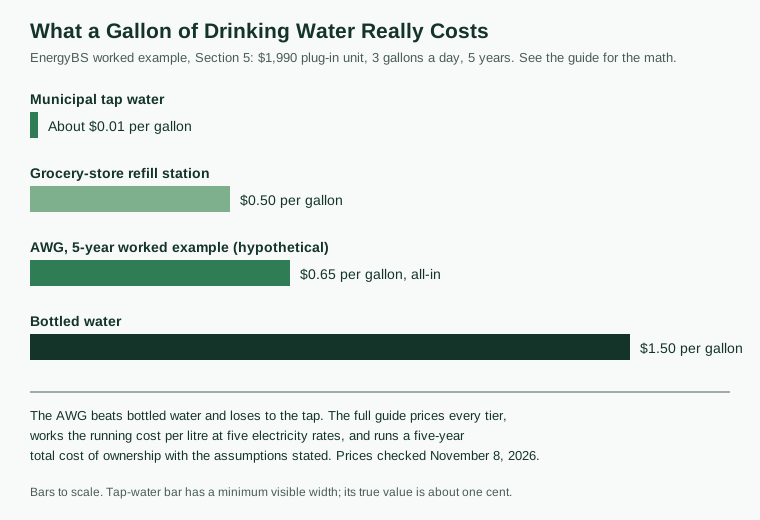
Assumptions: a $1,990 countertop unit in the Solaris A20 class, real output 3 gallons a day (below its 5.28-gallon maximum, allowing for average humidity), energy use 1.25 kWh per gallon, electricity at $0.16/kWh, filters $100 a year, five-year life, no repairs.
| Line item |
Math |
Five-year cost |
| Unit |
$1,990 once |
$1,990 |
| Electricity |
3 gal/day x 365 days x 5 years = 5,475 gallons; 5,475 x 1.25 kWh/gal = 6,844 kWh; 6,844 x $0.16 |
$1,095 |
| Filters |
$100 a year x 5 |
$500 |
| Five-year total |
|
$3,585 |
| Cost per gallon |
$3,585 / 5,475 gallons |
$0.65 |
| Cost per litre |
$0.65 / 3.785 |
$0.17 |
| Cost per month |
$3,585 / 60 months |
About $60 |
The sensitivities show where the number moves. If real output falls to 1.5 gallons a day, the same unit makes 2,738 gallons in five years, electricity falls to $548, and the total is $3,038, or $1.11 per gallon. Output is the biggest lever in the whole calculation. If the electricity rate rises to $0.30/kWh at 3 gallons a day, electricity becomes $2,053, the total is $4,543, or $0.83 per gallon. If the unit lasts seven years instead of five at the same output, the total is $4,183 over 7,665 gallons, or $0.55 per gallon. Run your own output and rate through the same table before comparing models.
Whole-home example: Hydropack S, five years
The same method on Aquaria's own inputs for the Hydropack S, at $0.15/kWh and 30 gallons a day of real output: unit $13,999, installation $15,000 (the middle of the published range), electricity 54,750 gallons x 1.09 kWh/gal = 59,678 kWh x $0.15 = $8,952, filters $200 a year = $1,000, service $300 a year = $1,500. Five-year total $40,451, or $0.74 per gallon. The same system falls to about $0.47 per gallon over ten years on Aquaria's own table, because the $15,000 installation spreads over twice as much water. The horizon changes the answer, so compare systems on the same horizon and say which one you used.
6. Humidity Changes the Price per Gallon
An atmospheric water generator makes water from vapour, and vapour is not evenly distributed. Output falls as relative humidity falls, and the cost per gallon rises in step because the machine still draws power while it makes less water. Aquaria publishes city-by-city output for the Hydropack against its 86F and 80% relative humidity baseline:
| City |
Daily output |
Share of rated output |
| Miami, FL |
113 gallons |
85% |
| Houston, TX |
83 gallons |
62% |
| Austin, TX |
69 gallons |
52% |
| Los Angeles, CA |
65 gallons |
49% |
| San Francisco, CA |
48 gallons |
36% |
The same machine makes more than twice as much water in Miami as in San Francisco, and the energy cost per gallon roughly doubles along with it. Aquaria states the Hydropack works best with relative humidity above 30%, and that production falls off a cliff below 30% for compressor units generally. Desiccant panels keep working in dry air down to about 10% relative humidity, which is their real advantage, but at 3 to 5 litres a day per panel they solve a drinking-water problem, not a household-supply problem.
Independent research points the same way. A 2024 techno-economic analysis in ACS ES&T Engineering (Gayoso et al.) put the levelized cost of grid-powered atmospheric water harvesting at $0.06 per litre in a tropical climate, $0.09 per litre in a temperate climate and $0.17 per litre in an arid climate. With existing solar PV already paid for, those figures fell to $0.02, $0.04 and $0.09 per litre. Climate is a cost input, not a footnote. A buyer in Phoenix should price the machine on desert output, not on the brochure maximum, and a buyer in Toronto should price it on a year that includes a dry, heated winter indoors.
7. When an AWG Beats Bottled or Delivered Water, and When It Does Not
The test that matters is a comparison with what you pay now, per gallon, over the same years. Aquaria's comparison table gives the alternatives at ten years: drilling a new well $12,000 to $130,000+, water deliveries $36,000 to $96,000 ($300-$800 a month), bottled water for a three-person household $18,000 to $24,000 ($150-$200 a month), whole-house reverse osmosis on a marginal well $8,000 to $25,000, and a Hydropack at about $74,000. Municipal tap water costs about $0.005 to $0.01 per gallon, which no AWG can approach.
Against the worked example in Section 5, at $0.65 per gallon all-in:
- Bottled water at $1.50 a gallon: the AWG wins. A household drinking 3 gallons a day spends $1,643 a year on bottled water and $712 a year on the AWG all-in, saving about $931 a year. The $1,990 unit pays for itself in about 2.1 years on that saving alone. This is the case that justifies a countertop unit.
- Grocery-store refill at $0.50 a gallon: the AWG loses by $0.15 a gallon. The refill station is cheaper, and it needs no maintenance, no filters and no electricity.
- Water deliveries at $300 to $800 a month: the AWG wins at whole-home scale. A Hydropack at about $0.34 per gallon over ten years undercuts any delivery price, and it removes the logistics entirely.
- A new well at $40,000 to $80,000 with no guarantee of hitting good water: the AWG competes. Aquaria's framing is that a known cost beats a gamble on geology, and the ten-year totals support that where drilling is expensive and uncertain.
- Safe municipal tap water plus a certified filter or reverse-osmosis system: the AWG loses every time. A $300 to $1,000 filter system costs about $1,800 over 15 years in our general guide's comparison, against $5,250 to $6,250 for a two-panel Hydropanel array and far more for a whole-home unit. If the tap is safe, filter it.
The break-even rule is simple: an AWG pays when the water it replaces costs more than its all-in cost per gallon, and the all-in figure must include the capital, the electricity at your rate, and the filters. Most buyers who regret the purchase skipped one of those three lines.
8. Financing: What the Monthly Payment Really Means
Aquaria offers $0 down, rates from 8.99%, and no payments for the first six months on approved credit, with terms up to 20 years. The monthly payments on the published prices are about $137 for the Hydropack S, $207 for the Hydropack and $330 for the X, and installation can be rolled into the financed amount.
Financing changes the cash-flow profile, not the total cost. The ten-year totals in Section 5 still apply, and interest adds to them. The useful comparison is the monthly payment against the monthly cost it replaces: $207 a month for a Hydropack against $300 to $800 a month in water deliveries is a clear saving, while $137 a month for a Hydropack S against a $15-a-month municipal water bill is not a saving at all. Ask for the total interest over the full term before signing, and compare it with paying cash for the unit and financing only the installation if the rates differ.
9. Canada: Prices, Power Rates, and Getting a Real Quote
No manufacturer-published Canadian pricing was found for Aquaria, SOURCE or WaterVO as of November 8, 2026. Aquaria is headquartered in Texas and prices in US dollars, WaterVO ships free anywhere in the US, and SOURCE pricing is reported in US dollars. A Canadian buyer should not convert a US price at the exchange rate and treat the result as a Canadian price, because shipping, duties, brokerage, and the installer's local rates all sit on top of it. Get a written quote that states each of those lines separately, and confirm who handles warranty service in Canada before paying.
What can be priced in Canada is the running cost, because Ontario's electricity rates are published. The Ontario Energy Board's Regulated Price Plan rates effective November 1, 2026 are 9.1 cents/kWh off-peak, 14.6 cents mid-peak and 18.9 cents on-peak in Canadian dollars, with tiered pricing at 11.2 and 13.2 cents and an ultra-low overnight rate of 3.7 cents/kWh from 11 p.m. to 7 a.m. Those are commodity prices only: delivery, regulatory charges and HST sit on top, and the Ontario Electricity Rebate is a 15.7% credit on the pre-HST bill.
For a plug-in unit at 1.25 kWh per gallon (0.33 kWh per litre), the commodity-only energy cost works out to:
| Ontario price period |
Rate (CAD/kWh) |
Energy cost per litre |
Energy cost per gallon |
| Ultra-low overnight |
3.7 cents |
C$0.01 |
C$0.05 |
| Off-peak |
9.1 cents |
C$0.03 |
C$0.11 |
| Mid-peak |
14.6 cents |
C$0.05 |
C$0.18 |
| On-peak |
18.9 cents |
C$0.06 |
C$0.24 |
The spread is the point: an AWG scheduled to run overnight on the ultra-low rate costs roughly a fifth of one running on-peak, in commodity terms, before delivery charges narrow the gap. If the unit has a timer or a smart plug, run it overnight. If it must run during the day, budget the mid-peak or on-peak figure, not the off-peak one.
Two more Canadian realities. First, winter output falls. A compressor unit in a heated Ontario home in January is pulling from dry indoor air, and a Hydropanel on a roof faces freezing temperatures and a low sun angle, so count on reduced production for December through February and keep a backup supply. Second, the electrical work is priced in Canadian dollars by Canadian electricians: RenoQuotes puts residential electricians at C$80 to C$150 an hour in 2026 and a 100A-to-200A service upgrade at C$2,500 to C$6,000. A whole-home AWG that needs a panel upgrade carries that cost in addition to the US-dollar unit price.