Whole House Water Filtration System Cost 2026: What Installation Really Costs
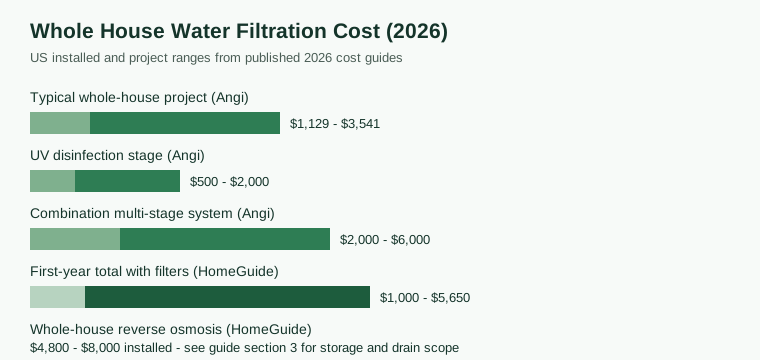
Installing a wholehouse water filtration system in the US in 2026 typically costs $1,129 to $3,541, with a national average near $2,275 in Angi project data. HomeGuide puts the firstyear total at $1,000 to $5,650 once equipment, labor and first filters are counted, and wholehouse reverse osmosis at $4,800 to $8,000. This guide prices carbon, multistage and UV systems, works through flowrate sizing, covers filter and lamp running costs, Canada pricing, and a quote checklist.
Quick Checks
- 1Budget $1,129 to $3,541 for a typical US whole-house filtration project in 2026. Angi puts the national average near $2,275, and HomeGuide puts the first-year total at $1,000 to $5,650 with equipment, labor and first filters counted.
- 2System type sets the price ladder: Angi prices UV disinfection at $500 to $2,000 and combination systems at $2,000 to $6,000, while HomeGuide prices whole-house reverse osmosis at $4,800 to $8,000 installed.
- 3Flow rate is the sizing decision. A system rated below your peak demand drops pressure at every simultaneous shower and tap, and no later filter change fixes an undersized housing.
- 4Running costs are filters, not energy. HomeGuide prices replacement filters at $15 to $65 each and UV lamps at $20 to $100, with Angi putting whole-house annual maintenance at $150 to $500.
- 5In Canada, WaterMart prices a whole-home system at $800 to $4,500 including installation, with high-end multi-stage work above $8,000.
Whole House Water Filtration System Cost 2026: What Installation Really Costs
By EnergyBS Editorial Team | October 9, 2026
The Short Answer
Short Answer: A whole-house water filtration system costs $1,129 to $3,541 for most US homeowners in 2026 in Angi project data, with a national average near $2,275. HomeGuide counts the same job as a first-year total of $1,000 to $5,650, split into equipment and materials at $650 to $4,800, installation labor at $200 to $600, and first-year replacement filters at $150 to $250 on a do-it-yourself change. By system type, Angi prices whole-house systems at $1,500 to $10,000, UV disinfection at $500 to $2,000, and combination systems at $2,000 to $6,000. HomeGuide prices whole-house reverse osmosis apart from the rest, at $4,800 to $8,000 installed. In Canada, WaterMart prices a whole-home system at $800 to $4,500 including installation. The spread is three decisions priced in order: what your water actually needs treated, how much water the house uses at peak, and whether the plumbing at the entry point is ready.
Filtration belongs on an energy site for a narrower reason than softening. Sediment and scale-forming debris reach the water heater, the dishwasher, and the washing machine first, and the heater pays for it in longer run times and service calls. Our water softener installation cost guide prices the companion purchase that handles hardness minerals. This guide prices filtration on its own terms, from the published 2026 tables, and keeps the boundary between the two jobs visible throughout.
1. Test First: What the Water Actually Needs
A filter treats named contaminants at a rated flow. A quote written before the water is tested is a product list, not a treatment plan.
Angi prices water quality testing at $50 to $200 and advises testing before committing to a system. Three levels of test answer three different questions:
- The municipal report. Cities publish annual water quality reports for treated supply. The report states what was in the water when it left the plant, in measured units. It costs nothing and it is the right starting point for city water.
- A home screening test. Strips and drop kits read bands for chlorine, hardness, pH and a short list of metals. Good enough to confirm a taste, odor, or staining complaint exists. Not precise enough to choose a treatment stage.
- A lab test. A certified lab measures the specific list that decides the system: lead and other metals, bacteria on well supply, iron and manganese, and the organic compounds a carbon stage would be asked to handle. On well water, the bacterial result decides whether a UV stage belongs in the quote at all.
The test result then sorts the house into one of three buying positions. City water with a chlorine taste and odor complaint needs a carbon stage, and little else. City water with an older service line or a lab result showing lead needs a stage certified for that metal, at the point of use or the point of entry depending on where exposure happens. Well water with sediment, iron, or a positive bacteria count needs stages in sequence, because each stage protects the next one from fouling. Section 3 prices those positions separately, because they are different purchases that share a product name.
One certification point belongs before any price talk. Under the NSF and ANSI system summarized in the Ferguson certification guide, Standard 42 covers aesthetic effects such as chlorine taste and odor and particulates. Standard 53 covers health-related reductions such as lead, cysts, and specified volatile organic compounds, and a product is certified only for the contaminants named in its listing, not for the whole list. Standard 58 covers reverse osmosis systems, Standard 55 covers UV treatment, and material and lead-content standards cover what the housings and fittings themselves contribute. A box that says NSF certified without naming the standard and the contaminant is marketing. The listing is the claim.
2. What the Installed Price Covers
A standard point-of-entry installation, as US and Canadian installers scope the job, normally includes setting the housings or tanks on the main line where water enters the house, cutting in shut-off and bypass valves so the system can be serviced without shutting down the house, connecting any drain a backwashing stage needs, fitting an outlet where a UV stage or control head needs power, filling and flushing the media, and a flow and pressure check with water running at more than one tap.
Four items sit outside that base scope often enough to need a written answer before work starts:
- Pre-filtration. Angi lists a sediment pre-filter stage at $100 to $400 as an add-on. On sediment-heavy supply, the pre-filter is what keeps the main stage alive to its rated life, and a quote without one on dirty water is pricing a short-lived system.
- Bypass and shut-offs. Angi lists bypass or shut-off work at $75 to $250. A system without a bypass has to be removed from service for every filter change, which turns a 20-minute task into a house without water.
- Monitoring and extra stages. Angi lists water quality monitors at $150 to $600, each added filtration stage at $100 to $600, and remote monitoring at $200 to $800. Each one is optional, and each one should appear as its own line so it can be declined on its own.
- Permits, removal, and access. Angi notes permit needs vary by municipality, puts removal and disposal of an old system at $50 to $200, and flags pre-installation inspection where a whole-house job needs one. Finished basements, crawl-space entry points, and long runs from the meter to the install point all price into the labor figure in section 5.
One bundling note. A filtration system fitted alongside a softener shares the entry-point pipe work, the bypass, and part of the plumber visit. Angi prices adding a softener alongside filtration at $1,000 to $2,500. The pairing question belongs in the first quote, even when the answer is to stage the purchases. The heater these stages protect is priced in our tank water heater replacement cost guide, which is where the avoided scale and sediment work shows up as equipment life.
3. Price by System Type: Carbon, Multi-Stage, UV, and Reverse Osmosis
The treatment method decides both the price and what a treated sample tests at afterward. Four types cover nearly every residential quote:
| System type | Installed or project cost, US | What it treats |
|---|---|---|
| Sediment plus carbon, point of entry | Inside the $1,000 to $5,650 first-year band (HomeGuide) | Sediment, chlorine taste and odor |
| Whole-house system, all types | $1,500 to $10,000 (Angi); $850 to $5,400 new (HomeGuide repair guide) | Every tap, scope varies by stage |
| UV disinfection | $500 to $2,000 (Angi) | Bacteria and viruses, needs clear water and power |
| Combination system | $2,000 to $6,000 (Angi) | Multiple stages in one train |
| Whole-house reverse osmosis | $4,800 to $8,000 (HomeGuide) | Dissolved solids across the full supply, needs storage and drain |
Read the two cost guides together and the standard purchase comes into focus. A single-stage or two-stage carbon system on city water, professionally installed on a prepared entry point, sits in the lower half of Angi's typical band. A well-water train with sediment, iron handling, carbon, and UV sits in the upper half, or beyond it. Whole-house reverse osmosis is its own purchase: HomeGuide prices the unit class apart from the rest of the table because it needs a storage tank sized to the house, a pump on most installs, and a drain for the reject stream, none of which a carbon housing needs.
Three distinctions keep quotes comparable:
Carbon treats taste, odor, and named chemicals. It does not disinfect. A carbon stage reduces chlorine and, where its listing names them, specified organic compounds and metals. It does nothing to bacteria or viruses. A house on treated city water with a taste complaint is buying the right product. A house on a well with a bacteria count is not, no matter how large the carbon tank is.
UV disinfects. It does not filter. A UV chamber inactivates bacteria and viruses as water passes a lamp. It removes no sediment, no iron, and no chemical, and turbid water shields microbes from the light, which is why UV sits last in a well-water train, after the stages that clear the water. The lamp needs power and an annual lamp change, priced in section 6.
Reverse osmosis belongs at one tap in most houses. HomeGuide prices under-sink reverse osmosis at $300 to $950 installed against $4,800 to $8,000 for a whole-house system, and Angi prices point-of-use reverse osmosis inside the same system table. Treating shower and laundry water through a membrane buys capacity, storage, and reject water that the drinking tap never needed. Whole-house RO has real uses, usually a specific dissolved-solids problem across the full supply, and it should be quoted as the specialty job it is rather than the default upgrade.
4. Flow Rate: The Sizing Decision That Sets the Housing Size
Filtration is sized in gallons per minute at peak demand, not in gallons per day. A system that treats every gallon the house uses across a day but cannot treat the gallons a shower, a dishwasher, and a tap draw in the same minute will drop pressure exactly when the house is awake.
The sizing method is fixture arithmetic, and it can be done on the quote before anyone orders a housing. Count the outlets that can run at once on a normal morning and add their flows. The figures below are a labeled worked example with the fixture flows stated, not a standard for any house:
| Outlet running at once, labeled example | Assumed flow | Subtotal |
|---|---|---|
| Shower | 2.0 gal/min | 2.0 gal/min |
| Second shower or tub fill overlapping | 2.0 gal/min | 4.0 gal/min |
| Kitchen tap | 1.5 gal/min | 5.5 gal/min |
| Dishwasher or washing machine fill | 1.5 gal/min | 7.0 gal/min |
| Peak the system must pass | About 7 gal/min |
A two-bath house running both showers plus one appliance at peak needs a system rated comfortably above that 7 gal/min figure, because a filter's rated flow is measured clean, and pressure drop rises as the cartridge loads. A larger house, or one with a high-flow tub filler, moves the peak up in the same arithmetic. Your fixture count and your overlaps are the inputs; a quote should state the rated flow it is selling and the peak it sized against.
Two failure modes follow from getting this wrong, and they are not symmetric. An undersized housing restricts every simultaneous use from the first day, and the restriction worsens between filter changes. An oversized housing costs more up front and, on carbon media, can channel if flow runs far below rating for long stretches, but it does not announce itself at the shower. Between the two, installers size to the stated peak with headroom, and the headroom is the line to ask about. Housing size also sets the filter bill in section 6: larger housings take larger, less frequent cartridges, and the annual filter figure on the quote should name the cartridge size it assumes.
Pressure deserves one direct note. Every stage adds pressure drop, and the drop grows as the stage loads with what it caught. A house that starts at low street pressure, or at the end of a long service line, feels a multi-stage train sooner than a house at strong pressure. A pre-install pressure reading, and a post-install reading at peak flow, belong on the completion paperwork. Without them, a later pressure complaint has no baseline to argue from.
5. Labor and the Site Conditions That Move It
HomeGuide puts filtration installation labor at $200 to $600 across system sizes, inside the first-year totals of section 3. Angi prices plumber time at $45 to $200 an hour, puts basic systems at one to two hours, and puts whole-house systems at four to eight hours or more. The two guides describe the same job from opposite sides: HomeGuide as the line on the invoice, Angi as the hours behind it.
Four site conditions explain most of the spread between quotes on the same equipment:
- Entry point access. A main line entering an open utility room is standard work. The same line entering a crawl space, a finished wall, or a tight closet is slower work, and the housings still need room for a wrench swing at every filter change afterward.
- Pipe material and condition. Cutting into sound copper or PEX is the base case. Galvanized, undersized, or corroded pipe at the entry point turns a filter job into a partial repipe, and a complete quote separates the two scopes so the repiping can be judged on its own.
- Drain and power. A backwashing stage needs a drain it can reach. A UV stage needs an outlet. Creating either one is electrical or drain work priced on top of the filtration labor, and it should be named rather than absorbed.
- What comes out. Removing a failed prior system, including a loaded tank, is labor and disposal. Angi puts old-system removal at $50 to $200, and the quote should state whether haul-away is in the figure.
The do-it-yourself boundary is visible in both guides. Cartridge housings on ready plumbing, with shut-offs and a bypass already present, are within reach of an experienced owner, and HomeGuide prices the annual filter change as a do-it-yourself task. A first-time point-of-entry cut-in, a backwashing tank that needs a drain, or a UV chamber that needs power is plumber work for most owners. The warranty position also splits here: manufacturer cover on a self-installed unit generally covers the unit, while installer cover extends to leaks and fittings. A quote should say which one it carries.
6. Running Costs: Filters, Lamps, Water, and Repairs
The installed price is the first of two costs. The second is smaller, annual, and predictable enough to budget on the day the system goes in.
Filters. HomeGuide prices carbon, sediment, and iron replacement filters at $15 to $65 each, and its filtration guide puts annual replacement filters at $150 to $250 for a whole-house system changed by the owner. Angi prices individual filter replacements at $20 to $200 depending on type, and whole-house annual maintenance at $150 to $500, with an optional professional service visit at $100 to $300 a year. The two guides overlap because they count different scopes: cartridges in hand against a maintained system. Either way, the figure is a filter bill, not an energy bill, and a quote that sells a low installed price against an unstated cartridge size is moving cost from one column to the other.
UV lamps. HomeGuide prices UV lamp replacements at $20 to $100 each. A UV stage also draws power continuously to keep the lamp lit, which Angi counts inside general operating costs of $2 to $10 a month across treatment types. The lamp change is annual on most residential chambers, and a chamber run past its lamp life is a housing with water passing through it, not a disinfection stage. The install date and the lamp date belong on the same sticker, on the chamber itself.
Water. Carbon and sediment housings use no water beyond what the house draws. Backwashing stages and whole-house reverse osmosis do: both send a reject or flush stream to a drain as part of normal operation. Angi flags reverse osmosis water waste as a line that raises the water bill, without pricing it as a single figure, because the amount follows from the membrane, the pressure, and the house demand. On a metered supply, that stream is part of the operating cost of the RO decision in section 3. On a septic system, the discharge destination needs the same conversation our softener guide raises, because every stage that drains sends its water where the drain goes.
Repairs. HomeGuide prices whole-house filtration repairs at $200 to $500, covering filter changes and minor repairs inside three hours, with service time at $50 to $150 an hour and inspections at $65 to $180. Angi prices common repairs at $75 to $400 and major components such as tanks and membranes at $200 to $1,000 on a seven-to-fifteen-year cycle. A leaking housing, a failed valve, and a fouled membrane are the usual entries. None of them is a reason to replace a young system. Section 8 states the rule for when age changes that answer.
A compact way to hold the annual figure: cartridges or media at the HomeGuide band, one UV lamp where fitted, and one service inspection every year or two. For most single-train houses that lands at a few hundred dollars a year, stated here as an addition of the published lines above rather than a separate statistic, and worth confirming as three named lines on any maintenance plan a dealer offers to sell.
7. Filtration and Softening: Two Jobs That Share an Entry Point
The most common quoting error in this category is buying one job and expecting the other. The two systems sit in the same place, on the same pipe, and solve different problems:
| Question | Filtration stage | Ion exchange softener |
|---|---|---|
| What leaves the water | Sediment, chlorine, named chemicals or metals per listing | Calcium and magnesium hardness minerals |
| What a treated sample shows | Lower chlorine, sediment, or listed contaminant | Tests soft; hardness near zero |
| What it does not do | Does not remove hardness minerals as a class | Does not remove lead, bacteria, or sediment as a class |
| Typical US installed band | $1,129 to $3,541 typical (Angi) | $1,200 to $3,800 (HomeGuide, via our softener guide) |
Houses with hard, chlorinated city water and a scale problem need the softener, and may add a carbon stage ahead of it for taste and to protect the resin from chlorine exposure. Houses with soft but sediment-heavy well water need filtration and no softener at all. Houses with both problems need both jobs, sequenced with sediment first, and Angi's $1,000 to $2,500 figure for adding a softener alongside filtration is the published price of that pairing. Our water softener installation cost guide works through hardness testing and grain sizing on its own. A quote that uses the words softening and filtering as if they were one claim, without naming which stage does which, is the quote to slow down on.
The heater sits downstream of both decisions. Sediment that reaches a tank settles in it, and hardness that reaches a heating surface plates onto it. The replacement side of that exposure is priced in our tankless water heater installation cost guide and our tank water heater replacement cost guide, and the heat pump alternative in our heat pump water heater cost guide. Filtration does not rescue equipment that is already fouled through. It is the purchase that decides what the next heater lives with.
8. Lifespan, Service, and Repair-or-Replace
A filtration system is not one product with one lifespan. It is housings that last, media that is consumed, and one or two powered parts that age on their own clocks:
- Housings and tanks. The pressure vessels are the long-lived part of the system. Kept out of freezing conditions and changed with the O-rings their makers specify, they run across multiple media cycles. A cracked housing or a failed valve is a component repair, inside the ranges of section 6.
- Cartridges and media. This is the consumable clock, and it runs in months, not years. A cartridge run past its rated capacity passes water it no longer treats, and the symptom is the original complaint returning: taste, odor, staining, or pressure loss as the stage loads. The change interval on the quote should be stated in months at your demand, and the sticker on the housing should carry the last change date.
- Membranes and lamps. Reverse osmosis membranes and UV lamps are the mid-life components. Angi puts major components such as tanks and membranes at $200 to $1,000 on a seven-to-fifteen-year replacement cycle, and the UV lamp change is annual at the HomeGuide lamp price. A membrane that has lost rejection or a lamp past its hours is a stage that occupies pipe without treating water.
The repair-or-replace rule follows the same shape as the rest of our cost guides, applied to the published repair bands. A system whose housings and valves are sound and whose fault is a cartridge, a lamp, a seal, or a single membrane is a repair, inside HomeGuide's $200 to $500 whole-house band or Angi's $75 to $400 common-repair band. A system whose fault is a cracked tank, a failed control, and exhausted media arriving together, quoted near the price of the new-system bands in section 3, is a replacement conversation. Age alone does not decide it. The count of worn parts arriving at once does, and the comparison figure is the first-year total for the system that would replace it, not the cheapest housing on a shelf.
Two service habits decide whether any of this is visible in time. Keep the water test result the system was bought against, and retest when the house, the supply, or the complaint changes; a system sized and staged for one water profile is not evidence about another. And keep the install paperwork with the pressure readings of section 4, because a pressure or quality drift two years later is only measurable against the day-one baseline.
9. Buying in Canada
WaterMart prices the Canadian whole-home purchase at $800 to $4,500 including installation, with high-end systems above $8,000. Its breakdown by scope reads as follows (Canadian context as published by WaterMart):
| Scope, Canada | Published cost | Notes from the source |
|---|---|---|
| Whole-home system, typical | $800 to $4,500 including installation | Varies by technology, brand, and requirements |
| Basic carbon unit | $500 to $1,000 starting range | Equipment entry point before added stages |
| Carbon plus UV or softening | $1,500 to $5,000 | Price rises as stages are added |
| Whole-house reverse osmosis | $4,800 to $8,000 | Multiple stages, ultra-pure scope |
| High-end system | Above $8,000 | Beyond the typical band |
WaterMart counts installation, maintenance, and filter replacements as additional to the equipment figure in parts of its guide, so a Canadian quote should be compared installed-to-installed, not against an equipment-only column. The stage logic is the same as in the US sections: sediment ahead of carbon, UV last on well supply, softening as a separate job where hardness is the complaint. Municipal supply in most large Canadian cities is treated and chlorinated, which makes the carbon-for-taste purchase the common one, while well supply outside municipal reach is where the multi-stage trains of section 3 appear. A first quote in Canada should name the test result it answers, the rated flow it sized against, and the annual filter figure in Canadian dollars, the same three lines section 10 asks for on any quote.
10. How to Compare Quotes: A Checklist
Quotes for the same house can sit several thousand dollars apart while describing different treatment. These lines force the comparison onto the same scope:
- Test result attached: the lab or municipal figure the system answers, with the contaminants named, not a product brochure claim.
- Certification named per stage: NSF and ANSI standard and the specific contaminants in the listing, for each stage that makes a health claim.
- Rated flow stated: gallons per minute the system is rated at, and the peak fixture load it was sized against.
- Stage sequence named: sediment, carbon, treatment, UV in the order they will sit on the pipe, with the job of each stage in one line.
- Equipment separated from labor: housings or tanks, media, labor, and site work as separate lines, not one blended figure.
- Site work named: entry point, bypass, shut-offs, drain, and outlet, each stated as existing or included, with any repipe separated from the filtration scope.
- Drain destination: where backwash or reject water goes, named, with septic suitability confirmed where a septic system takes it.
- Running cost stated: cartridge or media type, size, change interval at your demand, and annual filter figure; UV lamp price and interval where fitted.
- Pressure baseline promised: pre-install pressure, and post-install pressure at peak flow, both to be left on the paperwork.
- Warranty split: housings, valves, media, lamp or membrane, and labor, each with its term, and whether installer cover extends to leaks and fittings.
- Removal included or not: haul-away of a prior system on replacement jobs, stated on the quote.
- Completion test: water drawn after install and compared against the target from line 1, before final payment.
A quote missing lines 1, 3, and 8 is not yet comparable to one that has them. The cheapest complete quote, treating the same contaminants at the same rated flow with the same site work, is the one to buy.
Frequently Asked Questions (FAQ)
How much does a whole-house water filtration system cost in 2026?
Most US homeowners pay $1,129 to $3,541 in Angi project data, with a national average near $2,275. HomeGuide puts the first-year total at $1,000 to $5,650, split into equipment and materials at $650 to $4,800, labor at $200 to $600, and first-year filters at $150 to $250. Angi prices whole-house systems overall at $1,500 to $10,000. In Canada, WaterMart prices a whole-home system at $800 to $4,500 including installation.
What is the difference between a water filter and a water softener?
A filter removes sediment, chlorine, and the chemicals or metals named in its certification listing. A softener removes calcium and magnesium hardness minerals. Treated water from a filter still tests hard, and softened water can still carry sediment or chlorine. Angi prices adding a softener alongside filtration at $1,000 to $2,500. Our softener cost guide covers hardness testing and sizing in full.
How much does whole-house reverse osmosis cost, and do I need it?
HomeGuide prices whole-house reverse osmosis at $4,800 to $8,000 installed, against $300 to $950 for an under-sink system. Whole-house RO treats shower and laundry water through a membrane, with storage and a reject stream to a drain. Most houses need RO at the drinking tap only. Whole-house RO fits a specific dissolved-solids problem across the full supply and should be quoted as that specialty job.
What size whole-house filter do I need?
Size by peak flow in gallons per minute: add the outlets that can run at once, with their flows, and choose a rating comfortably above that peak. The worked example in this guide, two showers plus a tap and an appliance at stated flows, peaks near 7 gal/min. A quote should state the rated flow and the peak it sized against. An undersized housing drops pressure at simultaneous use from the first day.
How much does it cost to run a whole-house filter each year?
Filters are the main cost. HomeGuide prices replacement filters at $15 to $65 each, annual whole-house filters at $150 to $250, and UV lamps at $20 to $100. Angi puts whole-house annual maintenance at $150 to $500, with optional professional service at $100 to $300 a year. Repairs run $200 to $500 in HomeGuide data and $75 to $400 for common work in Angi data.
Does a UV stage replace a filter?
No. UV inactivates bacteria and viruses in clear water. It removes no sediment, iron, or chemical, and cloudy water shields microbes from the light. UV sits last in a well-water train, after sediment and treatment stages have cleared the water. It needs power and an annual lamp change at $20 to $100 a lamp in HomeGuide pricing. A carbon or sediment stage does the filtering; the UV stage does the disinfecting.
Can I install a whole-house filter myself?
Cartridge housings on ready plumbing with shut-offs and a bypass in place are within reach of an experienced owner, and HomeGuide prices the annual filter change as an owner task. A first-time entry-point cut-in, a backwashing tank that needs a drain, or a UV chamber that needs an outlet is plumber work for most owners: HomeGuide puts labor at $200 to $600 and Angi at $45 to $200 an hour. Manufacturer cover on a self-installed unit generally excludes the installation itself.
What should I read next before deciding?
Start with the companion job at the same entry point: our water softener installation cost guide covers hardness and softening. Then price the equipment filtration protects in our tank water heater replacement cost guide and tankless water heater installation cost guide. For the heat pump water heating option, read our heat pump water heater cost guide.
Prices in this guide are planning ranges from the published 2026 sources cited above, not quotes for your house. Your test result, peak flow, stage sequence, entry-point readiness, and local labor decide the final figure. Test the water first, get itemized written quotes at the same rated flow and scope, and confirm the treated result at a tap before final payment.
What to Read Next
Water Softener Installation Cost 2026: What Installation Really CostsUse this next to compare the cost, incentive, installation, or operating-risk angle before you make a home energy decision.Sources and Verification
- Angi How Much Does a Water Treatment System Cost? [2026 Data], updated Sep 24, 2026 (national average $2,275 from 8,441 projects, typical range $1,129 to $3,541, wholehouse $1,500 to $10,000, UV $500 to $2,000, combination $2,000 to $6,000, testing $50 to $200, labor and maintenance figures)
- HomeGuide How Much Does a Home Water Filtration System Cost? (2026) (wholehouse materials $650 to $4,800, labor $200 to $600, annual filters $150 to $250, firstyear total $1,000 to $5,650)
- HomeGuide How Much Does a Reverse Osmosis System Cost? (2026) (wholehouse RO $4,800 to $8,000 installed, undersink RO $300 to $950 installed)
- HomeGuide How Much Do Water Filtration System Repairs Cost? (2026) (wholehouse repair $200 to $500, filters $15 to $65 each, UV lamps $20 to $100 each, new wholehouse system $850 to $5,400)
- WaterMart How Much Does a Home Water Filtration System Cost? (Canada: wholehome system $800 to $4,500 including installation, highend above $8,000, basic carbon $500 to $1,000, UV or softening added $1,500 to $5,000)
- Ferguson Water Filter Certification Guide, NSF/ANSI Standards (Standard 42 aesthetic effects, Standard 53 health effects, Standard 58 reverse osmosis, Standard 55 UV, material safety and leadfree standards)
Editorial Review
EnergyBS Editorial Team
EnergyBS publishes practical homeowner guides. Important program, product, and cost claims should be checked against the linked source and local project documents before you commit to work.
Related Guides
View All ArticlesWater Softener Installation Cost 2026: What Installation Really Costs
Installing a wholehouse water softener in 2026 typically costs $1,200 to $3,800 in the US for a saltbased ion exchange system, with most homeowners paying near $1,500. This guide prices singletank, dualtank and saltfree systems, works through graincapacity sizing, covers salt and regeneration running costs, Canada pricing, and a quote checklist.
Tank Water Heater Replacement Cost 2026: What Installation Really Costs
Replacing a standard tank water heater in 2026 typically costs $600$3,100 installed in the US for a 40 to 50gallon unit, and $1,100$3,000+ in Canada. This guide breaks down size, fuel, labor, code upgrades, repairvsreplace math, and running costs.
Tankless Water Heater Installation Cost 2026: Prices, AddOns and Payback
A tankless water heater costs $1,400$5,600 installed in the US in 2026, and C$2,800$6,500 for a typical Canadian gas install. This guide breaks down unit, labor, venting, gasline and panel addons, sizes the unit, and runs 20year payback math with stated assumptions against a new tank.