Water Softener Installation Cost 2026: What Installation Really Costs
Installing a wholehouse water softener in 2026 typically costs $1,200 to $3,800 in the US for a saltbased ion exchange system, with most homeowners paying near $1,500. This guide prices singletank, dualtank and saltfree systems, works through graincapacity sizing, covers salt and regeneration running costs, Canada pricing, and a quote checklist.
Quick Checks
- 1Budget $1,200 to $3,800 installed for a salt-based whole-house softener in the US in 2026. HomeGuide puts a new system in that band, and Angi puts the amount most homeowners pay near $1,500.
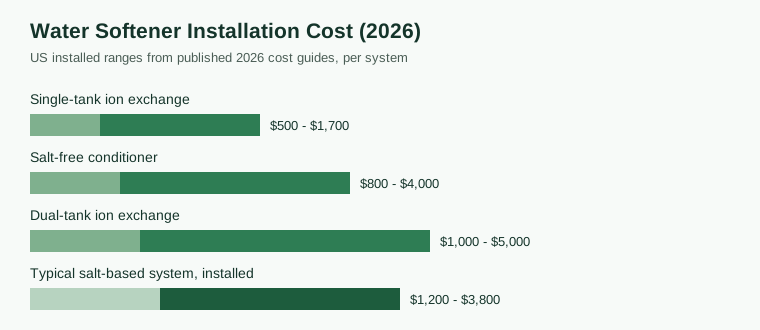
- 2The system type sets the equipment price: Angi prices single-tank ion exchange at $500 to $1,700, salt-free conditioners at $800 to $4,000, and dual-tank ion exchange at $1,000 to $5,000.
- 3Grain capacity is the sizing decision. Angi prices units by capacity from $300 to $500 at 24,000 grains up to $1,700 to $2,500 at 96,000 grains, materials only, and an oversized unit wastes salt at every regeneration.
- 4Installation labor is the smaller line on a prepared site: Angi puts it at $150 to $1,000 depending on unit type and complexity. A missing drain, a missing bypass, or a long pipe run is what moves a quote.
- 5In Canada, HomeStars prices a salt-based replacement at C$1,200 to C$3,500 installed, with plumber labour at C$90 to C$150 an hour and a straightforward swap at 3 to 5 hours.
Water Softener Installation Cost 2026: What Installation Really Costs
By EnergyBS Editorial Team | October 8, 2026
The Short Answer
Short Answer: A salt-based whole-house water softener costs $1,200 to $3,800 installed in the US in 2026 in HomeGuide's cost data, and Angi's 2026 figures put the amount most homeowners pay near $1,500, inside a wide normal range of $200 to $6,000 that runs from small magnetic units to whole-home reverse osmosis. By system type, Angi prices single-tank ion exchange at $500 to $1,700, salt-free conditioners at $800 to $4,000, and dual-tank ion exchange at $1,000 to $5,000. Installation labor on its own runs $150 to $1,000 in Angi's breakdown. In Canada, HomeStars prices a salt-based replacement at C$1,200 to C$3,500 installed. The spread is not noise. It is three decisions priced in order: how hard your water is, how much of it you use, and whether the plumbing at the install point is ready.
A softener earns a place on an energy site because hard water is an appliance problem before it is a comfort problem. Calcium and magnesium plate out on heating surfaces and inside flow paths, and the equipment that pays for it is the water heater, the dishwasher, and the washing machine. Our tank water heater replacement cost guide prices the appliance at the center of that exposure. This guide prices the softener from the published 2026 tables, works through the grain-capacity math that decides which unit a house needs, and covers the salt, water, and repair costs that continue after the install day.
1. Test First: Whether Your Water Needs Softening
A softener treats one measured condition, and the measurement comes before the quote. Angi's guide repeats the hardness classification used by the U.S. Geological Survey, stated in milligrams per litre of calcium carbonate: 0 to 60 mg/L is soft to slightly hard, 61 to 120 mg/L is moderately hard, 121 to 180 mg/L is hard, and above 180 mg/L is very hard. Softener sizing uses the same condition in grains per gallon, and the conversion is arithmetic: one grain per gallon is about 17.1 mg/L, so 180 mg/L reads as roughly 10.5 grains per gallon.
Three ways to get your number, in rising order of reliability:
- Your water bill or municipal report. Utilities publish hardness for treated municipal water, usually as mg/L or grains per gallon. It is free and it is the right starting point for sizing.
- A test strip. Cheap and fast, and it reads a band rather than a figure. Good enough to confirm a problem exists, not good enough to size a $1,500 system.
- A lab or dealer test. Measures hardness plus iron, manganese, and pH, which matter because iron changes the sizing math in section 4 and high iron can call for a filter stage ahead of the softener.
The decision line follows the bands. Below 3.5 grains per gallon (about 60 mg/L), scale forms slowly and a softener is a comfort purchase. Between 3.5 and 7 grains, the case rests on appliance exposure and how much hot water the house uses. Above 7 grains, and plainly above 10.5, scale control is the point of the purchase and the sizing math below decides the unit. A quote written before anyone states your hardness in grains per gallon is a guess with a price attached.
One boundary belongs here. A softener removes hardness minerals. It does not remove lead, PFAS, bacteria, or sediment, and a system sold as doing all of that in one tank deserves a slow read. Treatment stages solve different problems at different prices.
2. What the Installed Price Covers
A standard professional installation, as US and Canadian installers scope the job, normally includes setting the resin tank and brine tank at the main line entry point, cutting in a bypass valve, connecting the drain line for regeneration discharge, filling and starting the brine, programming the control head to your hardness figure, and a first regeneration cycle to confirm the system works. On a replacement, the scope is shorter: disconnect the old unit, set the new one on the existing loop, program it, and test.
Four items sit outside the base scope often enough that each one needs a written answer before work starts:
- The plumbing loop. Homes built with a softener loop have the cut-in point waiting. Homes without one pay for the pipe work, and Angi prices new pipe installation at $0.50 to $8 per linear foot depending on material and access. HomeStars prices a missing bypass or drain connection at C$100 to C$600 added to the job in Canada.
- The drain. Regeneration sends brine to a drain. A floor drain, laundry tub, or standpipe within reach keeps the job standard. A drain that has to be created, or a condensate pump to lift discharge to one, is a separate line.
- The electrical outlet. The control head needs a standard outlet near the tank. Angi prices new wiring installation at $2 to $4 per square foot as a general electrical figure, and a single added receptacle by an electrician is the smaller, common version of that line.
- Permits and inspection. Angi notes that building and inspection permit costs depend on local law. Plumbing permits for water treatment work are modest where they apply, and the installer should state whether your municipality wants one.
One bundling note. A softener fitted while a water heater is being replaced shares the plumber's visit, the drained-down system, and part of the pipe work. Our tankless water heater installation cost guide prices that companion job. The pairing question belongs in the first quote, even when the answer is to stage the two purchases a year apart.
3. Price by System Type: Ion Exchange, Salt-Free, and Dual-Tank
The method decides both the price and what the water tests at afterward. Angi's 2026 type table is the cleanest published split:
| System type | Average cost, US (Angi) | What it does |
|---|---|---|
| Single-tank ion exchange | $500 to $1,700 | Removes calcium and magnesium; regenerates on a timer or meter |
| Dual-tank ion exchange | $1,000 to $5,000 | Two resin tanks alternate, so soft water continues during regeneration |
| Salt-free conditioner | $800 to $4,000 | Conditions minerals so they plate out less; does not remove them |
| Magnetic | $200 to $600 | Clamp-on device; no plumbing cut-in |
| Reverse osmosis, point of use | $1,500 to $1,800 | Drinking-water stage at one tap, not whole-house softening |
| Reverse osmosis, whole home | $4,000 to $11,000 | Membrane treatment for the full supply |
HomeGuide's figures describe the same market from the installed side: a new softener system at $1,200 to $3,800 installed, and water softener installation at $800 to $3,000 in its plumber installation price list. Read together, the standard purchase (a single-tank salt-based unit, professionally installed, on a prepared loop) lands at $1,200 to $2,500 in most of the country, with Angi's near-$1,500 typical figure in the middle of it.
The salt-free row needs its distinction stated plainly, because the two products share shelf space and vocabulary. An ion exchange softener removes hardness minerals from the water; a treated sample tests soft. A salt-free conditioner changes the minerals so they form crystals that stick less to surfaces; a treated sample still tests hard, because the calcium is still in it. Our salt-free softener guide works through that difference in full. The buying consequence is direct: if the goal is scale control on a water heater plus the feel and soap behaviour of soft water, ion exchange is the product that does it. If the goal is less spotting and easier cleaning with no salt and no drain, a conditioner is a legitimate smaller purchase, priced accordingly.
Dual-tank pricing buys continuity, not softness. A single-tank system regenerates at a set hour, usually in the early morning, and delivers hard water while it does. Two tanks alternate so one is always in service. Houses that use water around the clock, large households that would exhaust a single tank between cycles, and light commercial use are the real buyers. For a typical family schedule, the premium buys a benefit that shows up a few nights a year.
4. Price by Grain Capacity, and the Sizing Math
Capacity is the second price dial, and it is the one most often set wrong. Angi prices units by rated grain capacity, materials only:
| Rated capacity | Unit price, US (Angi) |
|---|---|
| 24,000 grains | $300 to $500 |
| 32,000 grains | $400 to $1,000 |
| 48,000 grains | $600 to $1,200 |
| 64,000 grains | $800 to $1,500 |
| 80,000 grains | $1,500 to $1,800 |
| 96,000 grains | $1,700 to $2,500 |
The sizing method Angi publishes is a weekly grain budget. Multiply the people in the home by daily water use per person, by hardness in grains per gallon, by seven days. The worked example in Angi's guide runs four people at 90 gallons a day each against 10 grains per gallon, which gives 25,200 grains a week, and lands on a unit in the 32,000-grain class once reserve capacity is allowed for. The same formula at other hardness levels shows why hardness, not house size alone, drives the price:
| Household, labeled example | Hardness | Weekly grain load | Capacity class it points to |
|---|---|---|---|
| 2 people, 60 gal/day each | 7 gpg | 5,880 grains | 24,000 grains, regenerating about every 3 weeks at full rating |
| 4 people, 90 gal/day each | 10 gpg | 25,200 grains | 32,000 grains |
| 4 people, 90 gal/day each | 15 gpg | 37,800 grains | 48,000 grains |
| 6 people, 90 gal/day each | 15 gpg | 56,700 grains | 64,000 grains |
These are hypothetical examples computed from Angi's method, with the usage and hardness figures stated in the table. Daily use per person varies by household, and your measured hardness from section 1 is the input that matters. Three cautions belong with the math. First, iron adds to the load: the standard field adjustment adds grains for iron content, and your test result from section 1 is where that number comes from. Second, rated capacity is a maximum reached at a high salt dose; systems run more salt-efficiently below the rating, which is why installers size so the weekly load lands at roughly half to two-thirds of the nameplate. Third, the two failure modes are asymmetric. An undersized unit regenerates too often, wastes salt and water, and lets hardness through between cycles. An oversized unit regenerates too rarely, and resin sitting idle in hard water for long stretches has its own fouling problems. The right size is the one that regenerates about once a week in your house.
Metered controls belong in this section because they change the operating cost more than the purchase price. Angi advises choosing a meter-controlled valve that regenerates only when the water used calls for it, rather than a timer that runs on a fixed schedule whether the house used water or not. On a timer system in a house that travels, regeneration happens on schedule to an empty house, and the salt and water in section 6 are spent on nothing.
5. Installation Labor and the Site Conditions That Move It
Angi puts installation labor at $150 to $1,000 across system types, with the low end covering a basic system on a prepared loop and the upper end covering whole-house work with plumbing changes. HomeGuide's plumber price list describes the full installed job, equipment included, at $800 to $3,000. In Canada, HomeStars puts plumber labour at C$90 to C$150 an hour, reaching C$150 to C$200 an hour in major cities, and a straightforward softener swap in an accessible basement at 3 to 5 hours, for a labour portion of C$300 to C$600 on most projects.
Four site conditions explain most quote spreads on the same unit:
- Loop or no loop. A builder-installed softener loop makes the job a cut-and-connect. Its absence adds the pipe run priced in section 2.
- Drain distance. The brine tank needs a drain the regeneration line can reach by gravity, or a pump to lift it. Distance and lift both price into the job.
- Access and floor. A unit in an open utility room is standard work. A unit in a crawl space, a tight closet, or up a flight of stairs is slower work, and the tank still has to fit through the door.
- What comes out. Removing and disposing of a failed unit, especially a full resin tank, is labour and weight. A replacement quote should state whether haul-away is included.
The DIY boundary is visible in Angi's own range: its full scale starts at $150 to $200, which describes small self-installed units on ready plumbing. A whole-house cut-in with a bypass, a drain connection, and a programmed control head is plumber work for most owners, and the warranty position differs: a manufacturer warranty on a self-installed unit usually covers the unit, while an installer warranty covers the installation. Ask which one a quote carries.
6. Running Costs: Salt, Water, Electricity, and Rental
The installed price is the first of three costs. The second is consumables, and it is small and predictable.
Salt. Angi prices a 40-pound bag of softener salt at $5 to $10, and a 40-pound bag of potassium chloride, the alternative regenerant, at $50 to $70. A household's annual salt use follows from the sizing math: each regeneration consumes salt in proportion to the capacity restored. As a labeled example, a 32,000-grain system regenerating weekly at a mid-range salt dose uses roughly 6 to 10 bags a year, which at Angi's bag price is $30 to $100 a year in salt. The same system on potassium costs roughly ten times that in regenerant, which is why potassium is bought for specific reasons (sodium concerns, septic considerations) rather than by default.
Regeneration water. Each cycle flushes the resin bed to the drain. As a labeled example with the assumptions stated: a mid-size system using 50 gallons per regeneration, cycling weekly, sends about 2,600 gallons a year to the drain, which at a combined water-and-sewer example rate of $12 per thousand gallons is roughly $31 a year. Houses on a septic system should raise the discharge with the installer, since brine goes where the drain goes, and the local rules in section 2 apply.
Electricity. The control head draws a small continuous load and the valve motor runs during regeneration. It is a minor line beside the water heating equipment this purchase protects, and no published figure in this guide's sources prices it separately.
Rental. Angi lists softener rental at $25 to $50 a month as an alternative to purchase. The arithmetic is plain: at $40 a month, three years of rent is $1,440, near Angi's typical purchase figure, and the renter owns nothing at the end of it. Rental carries maintenance and salt service in many dealer programs, which is the actual product being bought. For a house you expect to leave within two years, renting can be the cheaper exit. For a house you expect to keep, purchase wins on the same math that makes the $1,200 to $3,800 band the standard buy.
Repairs. Angi puts softener repair at $150 to $900 on average, reaching $2,000 at the top. HomeGuide's repair guide frames the replacement decision that follows from it: replace a system that is more than ten years old, or one whose repair quote passes half the price of a new system. Section 8 applies that rule to the parts that actually fail.
7. The Energy Side: What Soft Water Protects
The softener itself uses little energy. The energy case sits downstream, in the equipment that heats and moves the water.
Scale is an insulator that forms exactly where heat crosses into water. In a tank water heater, mineral plates onto the tank bottom and the heating surfaces, and the burner or elements run longer to deliver the same water temperature through a growing mineral layer. Sediment from hard water also collects in the tank, and our water heater anode rod maintenance guide covers the companion maintenance that decides how long the tank itself survives. In a tankless unit, scale narrows the heat exchanger passages, and the descaling service in our tankless installation cost guide is the maintenance line that hard water makes more frequent.
Two framing cautions keep this section straight. First, this guide cites no percentage for softener energy savings, because the published sources behind it do not state one for residential softeners as a class, and the saving in any given house depends on hardness, hot water volume, and the equipment already scaled when the softener arrives. Second, a softener does not rescue equipment that is already scaled through. Descaling a tankless exchanger or replacing a failed tank is separate work, priced in the guides linked above. The softener is the purchase that stops the next unit from following the same path.
The appliance ledger beyond the water heater is shorter to state. Dishwashers and washing machines dose detergent against the water they are given, and soft water reaches the same result with less product; that is a consumables saving, not an energy one, and it shows up in the detergent budget rather than the utility bill. Fixtures and showerheads keep their flow rates instead of narrowing with mineral, which is a maintenance saving. The energy claim for a softener is real but indirect: it is the difference between heating water through clean surfaces and heating it through rock, compounded over the life of the equipment priced in our water heating guides.
8. Lifespan, Maintenance, and Repair-or-Replace
A softener is a 10-to-15-year class of purchase with a short maintenance list:
- Salt level. The brine tank should never run empty. Checking it monthly and refilling before the salt bridge forms over the brine is the whole routine. A salt bridge, a hard crust with a void under it, starves regeneration while the tank looks full, and it is the most common cause of a softener that quietly stops softening.
- Regeneration check. Treated water that tests hard again, spots returning to glass, or a system that has not regenerated in weeks each point to the same short list: empty brine, salt bridge, a clogged injector, or a control fault. These are the faults inside Angi's $150 to $900 repair range.
- Resin life. The resin bed is the wear part with the longest clock. Iron fouling and chlorine exposure shorten it, and a pre-filter on iron-bearing water is protection for the resin as much as for the water. Resin replacement on an otherwise sound tank is the repair that tests HomeGuide's rule: priced against a new system in the $1,200 to $3,800 band, it argues for replacement once the control head and tank are also ageing.
- The control head. Valves and seals wear, and a head that leaks or will not advance through its cycle is a replacement-grade fault on an old unit and a repair on a young one.
The replacement trigger, applying HomeGuide's rule directly: a system past ten years needing a resin bed, a control head, or any repair quoted above half the price of the new system it would be compared against, is a replacement. A younger system with a brine, injector, or seal fault is a repair, inside the published range. Age decides, the same as it did for the pumps and heaters in our other cost guides.
9. Buying in Canada
HomeStars' Canadian replacement guide prices the salt-based job at C$1,200 to C$3,500 installed, and its system table reads as follows (Canadian dollars, before tax):
| System type, Canada | Unit cost | Installed cost |
|---|---|---|
| Salt-based, single tank | C$800 to C$2,500 | C$1,200 to C$3,500 |
| Salt-free conditioner | C$1,000 to C$3,000 | C$1,500 to C$4,500 |
| Dual-tank, salt-based | C$1,500 to C$4,000 | C$2,000 to C$5,500 |
| Premium dealer brand, all-in | Included | C$4,000 to C$8,000 |
Labour sits at C$90 to C$150 an hour for plumbers in HomeStars' data, C$150 to C$200 in major cities, and the standard swap at 3 to 5 hours lands at C$300 to C$600 where a bypass and drain already exist, with C$100 to C$600 added where either has to be created. HomeStars notes that dealer-brand pricing typically includes a multi-year service warranty that other system types do not carry, which explains the premium row directly: the difference buys the service contract as much as the equipment.
Canadian buying notes that follow from those figures. Municipal hardness varies sharply by source water, and several Prairie and Great Lakes cities sit in the hard to very hard bands of section 1, so the test matters more, not less, north of the border. A first installation (rather than a replacement) prices off the same table with the loop and drain work from section 2 added where the house lacks them. And because the HomeStars table prices replacement, a Canadian quote for a first install should be compared against the installed column plus the named site work, not against the unit column.
10. How to Compare Quotes: A Checklist
Quotes for the same house can sit $1,000 apart while describing different systems. These lines force the comparison onto the same scope:
- Hardness stated: your tested grains per gallon (and iron, if present) written on the quote, with the municipal or lab source named.
- System type named: single-tank, dual-tank, or salt-free conditioner, with the words ion exchange where that is the claim.
- Grain capacity and the sizing math behind it: household size, daily use, hardness, and the regeneration interval the size is meant to produce.
- Control type: metered (demand-initiated) or timer, and the salt dose per regeneration the settings imply.
- Unit price separated from installation: equipment, labour, and site work as three lines, not one blended figure.
- Site work named: loop, bypass, drain route, and outlet, each stated as existing or included.
- Salt supply: first fill included or not, bag size, and the expected bags per year at your hardness.
- Discharge destination: floor drain, tub, standpipe, or septic, named, with local rule confirmed where septic is involved.
- Warranty split: tank, control head, resin, and labour, each with its term, and noting whether dealer pricing includes a service warranty.
- Haul-away: removal and disposal of the old unit on replacement jobs, included or not.
- Water test at completion: treated water tested soft at a tap after the first regeneration, before final payment.
- Rental comparison, if offered one: monthly figure, term, what service it includes, and the total paid over the term against the purchase price.
A quote missing lines 1, 3, and 6 is not yet comparable to one that has them. The cheapest complete quote, describing the same capacity at the same hardness with the same site work, is the one to buy.
Frequently Asked Questions (FAQ)
How much does it cost to install a water softener in 2026?
A salt-based whole-house system costs $1,200 to $3,800 installed in the US in HomeGuide data, and Angi puts the amount most homeowners pay near $1,500. By type, Angi prices single-tank ion exchange at $500 to $1,700, salt-free conditioners at $800 to $4,000, and dual-tank systems at $1,000 to $5,000. Installation labour alone runs $150 to $1,000. In Canada, HomeStars prices a salt-based replacement at C$1,200 to C$3,500 installed.
What size water softener do I need?
Size by weekly grain load: people in the home, times daily water use per person, times hardness in grains per gallon, times seven days. Four people at 90 gallons a day each against 10 grains per gallon gives 25,200 grains a week, which points to a 32,000-grain unit. Angi prices units from $300 to $500 at 24,000 grains up to $1,700 to $2,500 at 96,000 grains, materials only. Get your hardness tested before sizing; the hardness figure moves the answer more than household size does.
Is a salt-free water softener as good as a salt-based one?
They do different things. A salt-based ion exchange system removes calcium and magnesium, and treated water tests soft. A salt-free conditioner changes the minerals so they stick less, and treated water still tests hard. Angi prices salt-free at $800 to $4,000 against $500 to $1,700 for single-tank ion exchange. If the goal is soft water and scale removal, ion exchange is the product. Our salt-free softener guide works through the distinction in full.
How much does it cost to run a water softener?
Salt is the main consumable: Angi prices a 40-pound bag at $5 to $10, against $50 to $70 for potassium chloride. A mid-size system regenerating weekly uses roughly 6 to 10 bags a year, or $30 to $100 at those prices. Regeneration also sends water to the drain, about 2,600 gallons a year at a labeled 50-gallon weekly cycle. Repairs run $150 to $900 on average in Angi data. Rental, the no-purchase option, runs $25 to $50 a month.
How long does a water softener last, and when should I replace it?
Plan on a 10-to-15-year class of service with monthly salt checks. The wear points are the brine system, the injector, seals, the control head, and eventually the resin bed. HomeGuide's rule: replace a system that is more than ten years old, or one whose repair quote passes half the price of a new system, with new systems at $1,200 to $3,800 installed. A younger system with a salt bridge, injector, or seal fault is a repair inside Angi's $150 to $900 range.
Does a water softener save energy?
Indirectly. Scale insulates the surfaces that heat your water, so a water heater in hard water runs longer to deliver the same temperature, and tankless exchangers need descaling more often. A softener stops that buildup on the next unit and slows it on the current one. This guide cites no percentage saving, because its sources do not publish one for residential softeners as a class; the saving depends on your hardness, hot water use, and equipment condition.
Can I install a water softener myself?
A small unit on an existing softener loop is within reach of an experienced DIY plumber, and Angi's range starting near $150 to $200 describes that end of the market. A first-time whole-house cut-in with bypass, drain, and control programming is plumber work for most owners: Angi puts professional installation labour at $150 to $1,000, and HomeStars prices a Canadian swap at 3 to 5 hours. Note the warranty difference: manufacturer cover on a self-installed unit usually excludes the installation itself.
What should I read next before deciding?
Start with the appliance the softener protects: our tank water heater replacement cost guide and tankless water heater installation cost guide price the equipment on both sides of the decision. For the salt-free comparison in depth, read our salt-free softener guide. If the basement work is part of a larger waterproofing scope, our sump pump installation cost guide prices the drainage half of the same project.
Prices in this guide are planning ranges from the published 2026 sources cited above, not quotes for your house. Hardness at your tap, household water use, system type and capacity, loop and drain readiness, permits, and local labour decide the final figure. Test your water first, get itemized written quotes on the same capacity and scope, and confirm soft water at a tap after the first regeneration before final payment.
What to Read Next
Tank Water Heater Replacement Cost 2026: What Installation Really CostsUse this next to compare the cost, incentive, installation, or operating-risk angle before you make a home energy decision.Sources and Verification
- Angi Water Softener System Installation Cost [2026 Data], updated Aug 3, 2026 (national average near $1,500, normal range $200 to $6,000, installed pricing by system type and grain capacity, installation labor $150 to $1,000, salt and potassium pricing, repair range)
- HomeGuide How Much Does Water Filtration System Repair Cost? (2026) (new water softener system $1,200 to $3,800 installed; replace a system that is 10+ years old or needs repairs over half the price of new)
- HomeGuide 2026 Plumber Cost Per Hour (water softener installation $800 to $3,000 in the plumber installation price list)
- HomeStars Cost to Replace a Water Softener in Canada 2026 (saltbased replacement C$1,200 to C$3,500 installed, systemtype table, plumber labour C$90 to C$150 an hour, 3 to 5 hour swap, bypass and drain additions C$100 to C$600)
Editorial Review
EnergyBS Editorial Team
EnergyBS publishes practical homeowner guides. Important program, product, and cost claims should be checked against the linked source and local project documents before you commit to work.
Related Guides
View All ArticlesTank Water Heater Replacement Cost 2026: What Installation Really Costs
Replacing a standard tank water heater in 2026 typically costs $600$3,100 installed in the US for a 40 to 50gallon unit, and $1,100$3,000+ in Canada. This guide breaks down size, fuel, labor, code upgrades, repairvsreplace math, and running costs.
Tankless Water Heater Installation Cost 2026: Prices, AddOns and Payback
A tankless water heater costs $1,400$5,600 installed in the US in 2026, and C$2,800$6,500 for a typical Canadian gas install. This guide breaks down unit, labor, venting, gasline and panel addons, sizes the unit, and runs 20year payback math with stated assumptions against a new tank.
SaltFree Water Softeners (2026 Guide & Data)
Everyone hates hauling 40lb bags of salt. 'SaltFree Conditioners' claim to prevent scale without the salt. Do they work? Yes and No.