Well Pump Replacement Cost 2026: What Replacement Really Costs
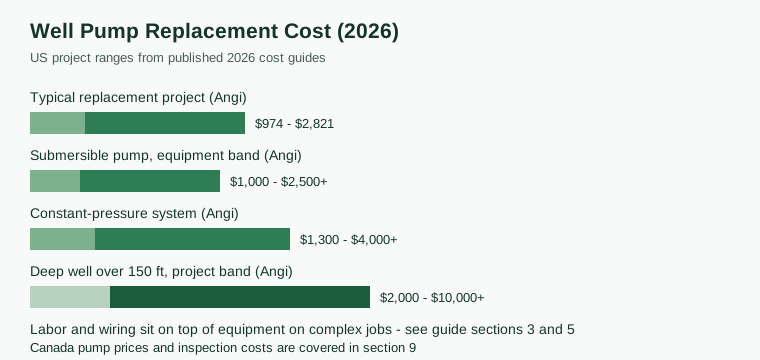
Replacing a well pump in the US in 2026 typically costs $974 to $2,821, with a national average near $1,897 in Angi project data from 1,339 projects. Pump type and well depth set the spread: shallow jet equipment runs $450 to $1,500 before installation lines, submersible equipment $1,000 to $2,500 or more, and wells over 150 feet land at $2,000 to $10,000 or more as projects. This guide prices each pump type, works through flow and pressuretank sizing, covers electricity running costs with labeled math, Canada pricing, and a quote checklist.
Quick Checks
- 1Budget $974 to $2,821 for a typical US well pump replacement in 2026. Angi puts the national average near $1,897 across 1,339 reported projects, with pump type and well depth driving the spread.
- 2Depth reprices the whole job: Angi bands projects at $400 to $3,000 or more under 25 feet, $1,200 to $5,500 or more at 25 to 150 feet, and $2,000 to $10,000 or more past 150 feet.
- 3Labor is a separate line on complex work. Angi puts replacement labor at $250 to $1,000, contractor time at $45 to $150 an hour, and electrical work at $50 to $100 an hour.
- 4A short-cycling pump is often a pressure-tank or switch fault, not a dead pump. Test the tank drawdown and switch settings before approving a full replacement quote.
- 5In Canada, HomeStars prices submersible pumps at $1,000 to $2,500 and jet pumps at $400 to $1,400, with labour at $80 to $150 an hour.
Well Pump Replacement Cost 2026: What Replacement Really Costs
By EnergyBS Editorial Team | October 9, 2026
The Short Answer
Short Answer: A well pump replacement costs $974 to $2,821 for most US homeowners in 2026 in Angi project data, with a national average near $1,897 across 1,339 reported projects. The pump itself explains most of the spread. Angi bands shallow jet equipment at $450 to $1,500, deep-well jet equipment at $800 to $2,200 or more, submersible equipment at $1,000 to $2,500 or more, and constant-pressure systems at $1,300 to $4,000 or more, each before pipework and wiring work is added. Depth then scales the labor: Angi bands whole projects at $400 to $3,000 or more for wells under 25 feet, $1,200 to $5,500 or more at 25 to 150 feet, and $2,000 to $10,000 or more past 150 feet. In Canada, HomeStars prices submersible pumps at $1,000 to $2,500 and jet pumps at $400 to $1,400, with contractor labour at $80 to $150 an hour.
A private well has no water bill, and that fact hides what the system actually is: a small water utility owned by one house. The pump is its power plant. It lifts every gallon the house uses, it sets the pressure at every tap, and its electricity draw shows up on the same meter as the water heater downstream. The treatment stages that protect that heater are priced in our whole house water filtration cost guide and our water softener installation cost guide. This guide prices the pump that feeds both of them.
1. Diagnose First: Pump, Tank, Switch, or Power
No water at the taps has four common causes, and only one of them is a failed pump. A quote written before the cause is named prices the most expensive answer by default.
- The pressure switch. The switch starts and stops the pump at set pressures. A failed, fouled, or mis-set switch produces no-water and short-cycling complaints that read exactly like pump failure from inside the house.
- The pressure tank. A waterlogged tank, one whose internal air cushion is gone, makes the pump start at nearly every draw. The pump is healthy. The cycling is what will kill it if the tank fault runs for months.
- Power and controls. A tripped breaker, a failed control box on a submersible system, or damaged down-hole cable stops the pump without the pump itself failing. Angi counts new pipework and electrical wiring repairs as an added $250 to $1,000 in labor on replacement projects, which is the same trade visit that finds these faults.
- The pump. Worn stages, a seized motor, or a pump that has run dry through a low-water event. This is the replacement case, and it is confirmed by draw, pressure, and flow testing at the wellhead, not by the symptom list alone.
Angi lists the symptom set that brings most owners to the phone: low or no water at faucets, a pump running non-stop, noise from the pump, higher than usual utility bills, sediment in the water, air in the pipes, and dirty or foul-smelling water. Every item on that list has at least one cause outside the pump. Sediment points at the well or the treatment train. Air in the pipes points at suction-side or check-valve faults on jet systems. A rising electric bill with normal water points at a pump cycling against a failed tank, running far more starts per day than the system was set up for.
One test separates the cases before money moves. With the pump at rest and a tap open, a healthy tank delivers a drawdown volume between cut-out and cut-in pressure; a waterlogged tank delivers almost nothing before the pump restarts. Section 4 sizes that volume. A contractor who will not state the tank result, the switch settings, and the pump current draw on the diagnostic visit has not yet earned the replacement quote.
2. What the Installed Price Covers
A standard like-for-like replacement, as well contractors scope the job, normally includes pulling the old pump where it sits down-hole, setting the replacement at the recorded depth, splicing and sealing the electrical connection, reconnecting the drop pipe and safety line, sanitizing and flushing the well line on completion, and a pressure and flow check at the house with the tank cycling normally.
Five items sit outside that base scope often enough to need a written answer before work starts:
- New pipework and wiring. Angi puts added pipework and electrical wiring labor at $250 to $1,000 on complex jobs. A change of pump type, a jet system converted to submersible, or damaged drop pipe discovered on the pull all land here.
- The pressure tank. A tank found waterlogged during diagnosis is a separate part at a separate price. Replacing pump and tank in one visit shares the trip and the drain-down, and section 4 covers the sizing that decides which tank.
- The control box and cable. Submersible systems carry controls at the surface or in the motor. Cable condition is judged when the old pump comes up, and a cable replacement is depth-priced material plus the same pull already being paid for.
- Permits and inspection. Requirements vary by jurisdiction, and Angi advises confirming the contractor handles the permit process where one applies. HomeGuide prices a well inspection at $250 to $550 every 1 to 2 years, which is the visit that also documents casing and seal condition.
- Water testing after the work. Pulling a pump stirs a well. A post-work bacterial test belongs on the completion list. HomeGuide advises testing well water at least once a year through a certified laboratory, and a pump change is a reason to restart that clock, not skip it.
The bundling note runs in one direction here. Filtration, softening, and the heater all sit downstream of this pump, and none of them shares its labor. The one pairing that does share work is pump plus pressure tank, because both are open in the same visit. Our sump pump installation cost guide covers the other pump in a well-supplied house, the one that moves groundwater out of the basement rather than drinking water into it.
3. Price by Pump Type: Jet, Submersible, Constant-Pressure, Solar
The well decides the shortlist before the budget does. Depth to water and required flow rule out most of the catalogue, and what remains is a price ladder:
| Pump type | Equipment cost band, US (Angi) | Where it fits |
|---|---|---|
| Shallow jet pump | $450 to $1,500 | Wells 25 feet deep or less, pump sits above ground |
| Deep well jet pump | $800 to $2,200 or more | Jet configuration working to about 150 feet |
| Submersible pump | $1,000 to $2,500 or more | Pump sits in the well, the standard deep-well choice |
| Constant-pressure pump | $1,300 to $4,000 or more | Submersible with controls holding steady pressure |
| Solar pump | $1,800 to $6,500 or more | Off-grid supply where grid power is absent or costly to run |
| Hand pump | $400 to $1,500 | Manual backup or low-demand supply |
Read the table with the scope note Angi attaches to it: these are equipment bands, stated before installation, pipework, or wiring costs are added. The typical-project band of $974 to $2,821 from section 1 is what most like-for-like replacements actually total, because labor on a straightforward pull and reset sits inside it. The projects that leave that band do so for named reasons in section 5, depth first among them.
Three distinctions keep quotes comparable:
Jet pumps trade depth for serviceability. A shallow jet pump sits at the surface, where every part can be reached without pulling pipe from the well. That access is the whole value of the design, and it holds only where water sits within the shallow band Angi prices. A deep-well jet configuration reaches further with a down-hole ejector, at higher equipment cost and with more to go wrong at the suction side. Past the jet range, the comparison ends and submersible is the default, not an upgrade.
Submersible is the deep-well standard, and its price is depth in disguise. The pump and motor sit submerged, pushing water up rather than lifting it by suction. Equipment at $1,000 to $2,500 or more buys the unit; the depth of the set, the length of cable and drop pipe, and the pull equipment decide the rest of the invoice. Two houses buying the identical pump at different depths are not buying the same job.
Constant-pressure is a controls purchase, not a bigger pump. A constant-pressure system varies motor speed to hold one pressure as taps open and close, instead of cycling between switch settings against a large tank. Angi prices the class at $1,300 to $4,000 or more for the advanced controls. The gain is steady shower pressure and a smaller tank footprint. The cost is electronics at the wellhead and a repair path that runs through the controller. It solves a pressure complaint. It does not fix a well that cannot make the flow, and section 4 separates those two problems.
Solar belongs in the table for completeness. At $1,800 to $6,500 or more in Angi equipment pricing, it prices against the cost of running grid power to a remote well, not against the other pumps on a serviced lot.
4. Sizing: Flow First, Then Pressure, Then the Tank
A replacement sized from the old pump's label repeats the old pump's mistakes. Three numbers size the job independently, and a quote should state all three.
Flow, in gallons per minute. The pump must replace water at the rate the house draws it at peak, the same fixture arithmetic our filtration guide uses at the entry point. Count the outlets that can run at once and add their flows. The figures below are a labeled worked example with the fixture flows stated, not a rating for any house:
| Outlet running at once, labeled example | Assumed flow | Subtotal |
|---|---|---|
| Shower | 2.0 gal/min | 2.0 gal/min |
| Second shower or laundry fill overlapping | 2.0 gal/min | 4.0 gal/min |
| Kitchen tap | 1.5 gal/min | 5.5 gal/min |
| Dishwasher fill | 1.5 gal/min | 7.0 gal/min |
| Peak the pump and well must sustain | About 7 gal/min |
The well itself must also make that rate. A pump rated past the well's yield runs the well down and then runs dry, which is a pump-killing event, not a sizing margin. The contractor's flow test at the wellhead states the yield the sizing has to respect. A quote that names a pump flow without naming the tested well yield has done half the arithmetic.
Pressure, in switch settings. Household systems commonly cycle between a cut-in and a cut-out pressure set at the switch, and the tank in the next paragraph is sized against that band. Low-pressure complaints trace to three separate causes that price differently: switch settings set low, a pump worn to where it cannot reach cut-out against depth, or a well yield short of demand so pressure sags only at peak. Each one appeared in section 1 wearing the same symptom.
The tank, in drawdown gallons. The pressure tank is not storage for its own sake. Its drawdown volume, the water it delivers between cut-out and cut-in, sets how often the pump starts. Motors age by starts as much as by running hours, so drawdown is a pump-life decision. The sizing rule used on quotes is drawdown matched to pump flow: at minimum, enough drawdown to give the pump a full minute of run time per start, which at the labeled 7 gal/min example rate means at least 7 gallons of drawdown. Tank drawdown is a fraction of tank volume, set by the pressure band, so the tank on the quote will read several times larger than the drawdown it delivers. A quote should state both numbers. A system short-cycling on a healthy pump is usually this arithmetic done small, and the fix is the tank, priced as a part, not a second pump.
5. Depth, Labor, and the Site Conditions That Move the Price
Angi bands whole projects by depth, and the bands are the fastest sanity check on any quote:
| Well depth | Project cost band, US (Angi) |
|---|---|
| Under 25 feet | $400 to $3,000 or more |
| 25 to 150 feet | $1,200 to $5,500 or more |
| Over 150 feet | $2,000 to $10,000 or more |
Depth reprices three things at once. The pump needs more stages or a larger motor to lift against more head, which moves the equipment band in section 3. The pull takes longer and needs hoisting equipment rated for the hanging weight of pump, pipe, and cable. And the material column grows by the foot, because drop pipe and cable are bought at the set depth.
Labor itself is priced plainly in the same guide. Angi puts replacement labor at $250 to $1,000 depending on complexity, well contractor time at $45 to $150 an hour, and electrical work at $50 to $100 an hour. A shallow jet swap at the surface sits at the bottom of those bands. A deep submersible pull with pipework changes sits at the top, and a conversion, jet out and submersible in, adds the $250 to $1,000 pipework and wiring line from section 2 on top of the base labor.
Four site conditions explain most of the remaining spread between quotes on the same well:
- Casing size and condition. A narrow or damaged casing limits pump diameter and can turn a set into a negotiation with the well itself. The inspection visit, $250 to $550 in HomeGuide pricing, is where this is found before the truck rolls.
- What the pull reveals. Drop pipe, cable, and fittings are judged when they come up. Reusing sound pipe is the standard saving Angi names; replacing it is depth-priced material discovered mid-job, which is why a complete quote carries a stated per-foot or allowance line for it.
- Access at the wellhead. A wellhead buried, built over, or inside a structure that has grown around it adds excavation or demolition before pump work starts. That work is not in any band above and should be its own line.
- Emergency timing. A dry house does not shop on a schedule. Angi's saving guidance is built around the non-emergency case: compare at least three quotes, keep records of symptoms and dates to cut diagnostic time, and act on early signs while the job is still a repair conversation. The price difference between planned and emergency replacement is the premium the bands leave room for at the top.
The do-it-yourself boundary is stated firmly in the source and this guide keeps it. Angi advises against owner replacement: the work involves deep-well extraction, hoists and down-hole tools, and errors that produce reduced flow, contamination risk, system damage, and higher electric bills. A shallow jet pump on ready plumbing is the nearest case to owner work, and even there the priming and sealing steps decide whether the pump works at all. The warranty split follows the same line as our other cost guides: manufacturer cover reaches the unit, installer cover reaches the set, the splice, and the pressure result.
6. Running Costs: Electricity, Starts, and Service
The installed price is the first of two costs. The second is electricity plus a service rhythm, and it is small next to the heater the pump feeds, which is exactly why it gets ignored until it spikes.
Electricity. A well pump's energy use is wattage multiplied by running hours, and running hours follow household water use and tank drawdown. No source cited here publishes a single annual figure, because the inputs vary by house, so the example below is labeled math with its assumptions stated, not a statistic:
| Input, labeled example | Assumed value |
|---|---|
| Pump draw while running | 1,000 watts |
| Running time per day at stated household use | 1 hour |
| Electricity per year | 365 kWh (1 kW x 1 h x 365 days) |
| Cost at an assumed $0.15 per kWh | About $55 per year |
Your pump's nameplate or measured draw, your running hours, and your rate are the inputs. The diagnostic value of the math is the comparison, not the total. A pump that begins cycling against a waterlogged tank multiplies its starts and its running pattern without delivering one extra gallon, and Angi's symptom list puts the result where owners actually see it: higher than usual utility bills. The electric bill is a pump instrument that most houses already own.
Starting load matters on backup power rather than on the bill. A pump motor draws a multiple of its running wattage for the seconds it starts, and a generator or battery system sized to running loads alone can fail on that surge with the pump as the largest single motor in the house. Our home battery critical load sizing guide works through starting-surge sizing for well pumps as a critical load, and our standby home generator cost guide prices the generator side of the same decision. On a private well, an outage is also a water outage, so this pairing belongs in the replacement conversation whenever backup power already exists.
Service. HomeGuide prices a well inspection at $250 to $550 every 1 to 2 years and advises annual certified-lab water testing; HomeStars puts a Canadian annual inspection at about $300 to $500. Between visits, the owner-side checks are the ones section 1 named: watch cycle behavior at a running tap, note pressure changes, and date them. A contractor handed a symptom with a start date bills less diagnostic time than one handed a dry house and a shrug, which is the cheapest saving in this guide.
7. Lifespan and Repair-or-Replace
A well system ages in parts, on three different clocks:
- The pump. HomeStars puts the pump replacement cycle at 10 to 15 years depending on usage and system conditions. Runtime against depth, start frequency set by the tank, and water quality set the pace within that band. Sediment-heavy water wears stages; a short-cycling system wears the motor.
- The tank and switch. These are the mid-life parts, and they fail in the direction of section 1: the tank waterlogs, the switch contacts pit and drift. Either fault, run long enough, bills the pump for the damage. This is the mechanical argument for the $250 to $550 inspection rhythm in section 6.
- Pipe, cable, and casing. The long-lived column. Judged on each pull, replaced on condition, and the reason a pump replacement quote should never silently include or exclude them.
The repair-or-replace rule follows the shape of our other cost guides, applied to the published bands. A system whose fault is a switch, a control box, a tank, or cable damage, on a pump inside its expected life with sound flow and pressure when driven, is a repair. A pump at or past the 10 to 15 year band with worn flow, a seized or shorted motor, or a repair quote climbing toward the $974 to $2,821 typical replacement band is a replacement, and the comparison figure is the full installed band for the pump type in section 3, not the equipment price alone. Age alone does not decide it, in either direction. A young pump killed by a dry run is a replacement with a cause to fix, starting with the well yield and the low-water protection. An old pump meeting flow and pressure on test is a service visit and a dated note, with the replacement budgeted rather than rushed.
One record decides most of these arguments years later: the install paperwork. Pump model and horsepower, set depth, static water level, tested yield, switch settings, and tank size with its drawdown. Kept with the house, that sheet turns the next failure into a like-for-like quote over the phone. Without it, the next contractor prices a diagnostic pull first. Ask for it as a completion deliverable; section 8 puts it on the checklist.
8. Buying in Canada
HomeStars publishes the Canadian pump figures inside its water well drilling cost guide, and they read as equipment and system context for the same purchase:
| Item, Canada (HomeStars) | Published cost |
|---|---|
| Submersible pump | $1,000 to $2,500 |
| Jet pump | $400 to $1,400 |
| Solar pump | $1,500 to $6,500 |
| Contractor labour | $80 to $150 an hour |
| Annual inspection | About $300 to $500 |
HomeStars counts pumps as one component inside full well projects that run far higher, drilling included, so a Canadian replacement quote should be compared installed-to-installed: pump, labour at the stated hourly band, pipe and cable at the set depth, tank where included, and testing, each as its own line. The guide puts pump replacement on a 10 to 15 year cycle and water testing at least annually, the same rhythm as the US sources. Provincial and municipal rules govern who may service wells and what disinfection and testing follow a pump change, and they differ by province, so the quote should name the licensed contractor category doing the work rather than a generic plumbing licence. The stage logic north of the border is unchanged: diagnose before replacing, size flow and tank together, and treat the water the new pump will move, which our filtration and softener guides price for Canadian supply in their own Canada sections.
9. How to Compare Quotes: A Checklist
Quotes for the same dry house can sit several thousand dollars apart while describing different scope. These lines force the comparison onto the same job:
- Diagnosis stated: pump, tank, switch, controls, or power, with the test result for each, before a replacement is quoted.
- Pump type named with its fit: type, horsepower, and rated flow, matched to the well depth and the tested yield.
- Tested yield on paper: the well's measured gallons per minute, and the pump rate chosen against it.
- Tank arithmetic shown: tank size, pressure band, and drawdown gallons, with the run-time-per-start the drawdown buys.
- Set depth recorded: existing depth, any change, and the reason for the change.
- Equipment separated from labor: pump, tank, pipe, and cable as material lines; pull, set, and electrical as labor lines at stated rates.
- Pipe and cable condition priced: reuse stated, replacement carried as a per-foot or allowance line rather than discovered later.
- Electrical scope named: control box, cable splice standard, breaker and wiring work, each as existing or included.
- Disinfection and test included: well-line sanitizing on completion, and the post-work water test, with the lab named.
- Backup-power note where fitted: starting load of the chosen pump stated, for the generator or battery system that must start it.
- Warranty split: pump, tank, controls, and labor, each with its term, and whether installer cover extends to the set and splice.
- Install record promised: model, depth, static level, yield, switch settings, and tank details left with the house on completion paperwork.
A quote missing lines 1, 3, and 4 is not yet comparable to one that has them. The cheapest complete quote, treating the same well at the same flow and pressure with the same site work, is the one to buy.
Frequently Asked Questions (FAQ)
How much does well pump replacement cost in 2026?
Most US homeowners pay $974 to $2,821 in Angi project data, with a national average near $1,897 across 1,339 projects. Equipment bands in the same guide run from $450 to $1,500 for a shallow jet pump to $1,000 to $2,500 or more for a submersible, before pipework and wiring. Wells past 150 feet band at $2,000 to $10,000 or more as projects. In Canada, HomeStars prices submersible pumps at $1,000 to $2,500 with labour at $80 to $150 an hour.
What is the difference between a jet pump and a submersible pump?
A jet pump sits above ground and lifts water by suction, which limits the shallow class to wells of 25 feet or less in Angi's pricing bands; a deep-well jet configuration reaches to about 150 feet. A submersible pump sits in the well and pushes water up, making it the standard deep-well choice. The jet pump's parts can all be reached at the surface. The submersible must be pulled for service, which is why its labor follows well depth.
How long does a well pump last?
HomeStars puts the replacement cycle at 10 to 15 years depending on usage and system conditions. Start frequency does much of the damage inside that band: a pump short-cycling against a waterlogged pressure tank can spend its life early, which is why tank condition is part of every diagnosis in this guide. Sediment in the water and any dry-run event shorten the range further.
How do I know whether I need a pump, a tank, or a switch?
Run the drawdown test in section 1. Open a tap with the pump at rest and watch how much water arrives before the pump restarts, and how often it cycles at a steady draw. Near-zero delivery before restart points at the tank. No start at all points at switch, controls, or power. Weak flow with normal cycling, confirmed by current-draw and pressure testing at the wellhead, is the pump case. A contractor should state all three results before quoting replacement.
What size well pump and pressure tank do I need?
Size flow from peak fixture demand, the labeled example in section 4 lands near 7 gal/min, and confirm the well's tested yield meets it. Then size tank drawdown to give the pump at least a minute of run per start: at 7 gal/min, at least 7 gallons of drawdown, remembering drawdown is a fraction of tank volume set by the pressure band. The quote should state rated flow, tested yield, tank size, and drawdown as four numbers.
How much electricity does a well pump use?
It follows from draw multiplied by running time. The labeled example in section 6, a 1,000-watt pump running 1 hour a day at an assumed $0.15 per kWh, uses 365 kWh and about $55 a year. Your nameplate draw, running hours, and rate decide your figure. A sudden bill rise with normal water use is a listed failure symptom in Angi's guide, usually a pump cycling against a failed tank.
Can a generator or home battery run a well pump?
Yes, sized to starting load rather than running load. The motor draws a multiple of its running wattage for the seconds it starts, and that surge is what backup equipment must carry. Our home battery critical load sizing guide works through well pump starting surge directly, and our standby generator cost guide prices the generator option. On a private well, backup power is also backup water.
What should I read next before deciding?
Start downstream, with the water the pump delivers: our whole house water filtration cost guide and water softener installation cost guide price the treatment train at the entry point. Then price the equipment that drinks from it in our tank water heater replacement cost guide. For the basement side of groundwater, read our sump pump installation cost guide.
Prices in this guide are planning ranges from the published 2026 sources cited above, not quotes for your well. Your diagnosis, well depth and yield, pump type, tank sizing, and local labor decide the final figure. Test before replacing, get itemized written quotes at the same flow and pressure, and keep the install record with the house.
What to Read Next
Whole House Water Filtration System Cost 2026: What Installation Really CostsUse this next to compare the cost, incentive, installation, or operating-risk angle before you make a home energy decision.Sources and Verification
- Angi How Much Does Well Pump Replacement Cost? [2026 Data], updated Aug 31, 2026 (national average $1,897 from 1,339 projects, typical range $974 to $2,821, pumptype equipment bands, depth bands, labor $250 to $1,000 at $45 to $150 an hour, electrical work $50 to $100 an hour, added pipework and wiring labor $250 to $1,000)
- HomeGuide Water Well Service cost guidance (new well pump $400 to $2,500 by type on an existing well, well inspection $250 to $550 every 1 to 2 years, annual water testing by a certified laboratory)
- HomeStars Water Well Drilling Cost, Canada (submersible pump $1,000 to $2,500, jet pump $400 to $1,400, solar pump $1,500 to $6,500, labour $80 to $150 an hour, annual inspection about $300 to $500, pump replacement cycle 10 to 15 years)
Editorial Review
EnergyBS Editorial Team
EnergyBS publishes practical homeowner guides. Important program, product, and cost claims should be checked against the linked source and local project documents before you commit to work.
Related Guides
View All ArticlesWhole House Water Filtration System Cost 2026: What Installation Really Costs
Installing a wholehouse water filtration system in the US in 2026 typically costs $1,129 to $3,541, with a national average near $2,275 in Angi project data. HomeGuide puts the firstyear total at $1,000 to $5,650 once equipment, labor and first filters are counted, and wholehouse reverse osmosis at $4,800 to $8,000. This guide prices carbon, multistage and UV systems, works through flowrate sizing, covers filter and lamp running costs, Canada pricing, and a quote checklist.
Water Softener Installation Cost 2026: What Installation Really Costs
Installing a wholehouse water softener in 2026 typically costs $1,200 to $3,800 in the US for a saltbased ion exchange system, with most homeowners paying near $1,500. This guide prices singletank, dualtank and saltfree systems, works through graincapacity sizing, covers salt and regeneration running costs, Canada pricing, and a quote checklist.
Sump Pump Installation Cost 2026: What Installation Really Costs
Installing a sump pump in 2026 typically costs $600 to $2,500 in the US, with replacement in an existing pit at $400 to $700 and concrete floor work pushing a new pit to $2,500 to $5,000. This guide prices pedestal, submersible, battery backup and waterpowered options, works through sizing in gallons per hour, running cost, Canada pricing, and a quote checklist.